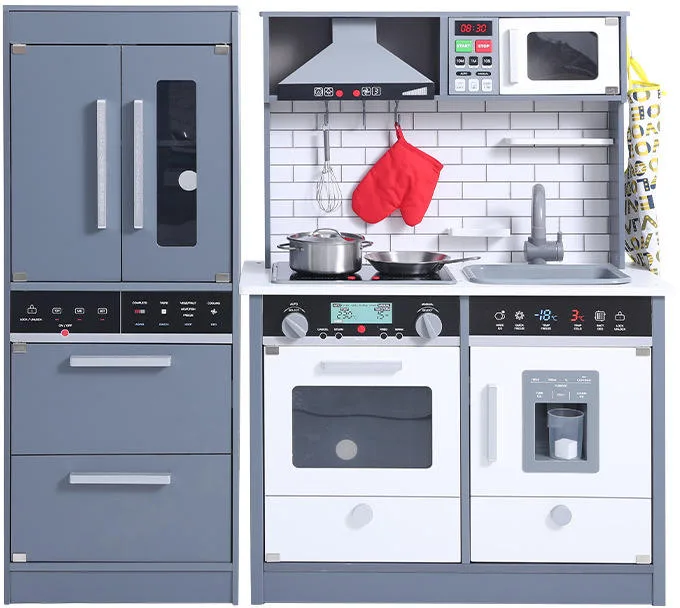
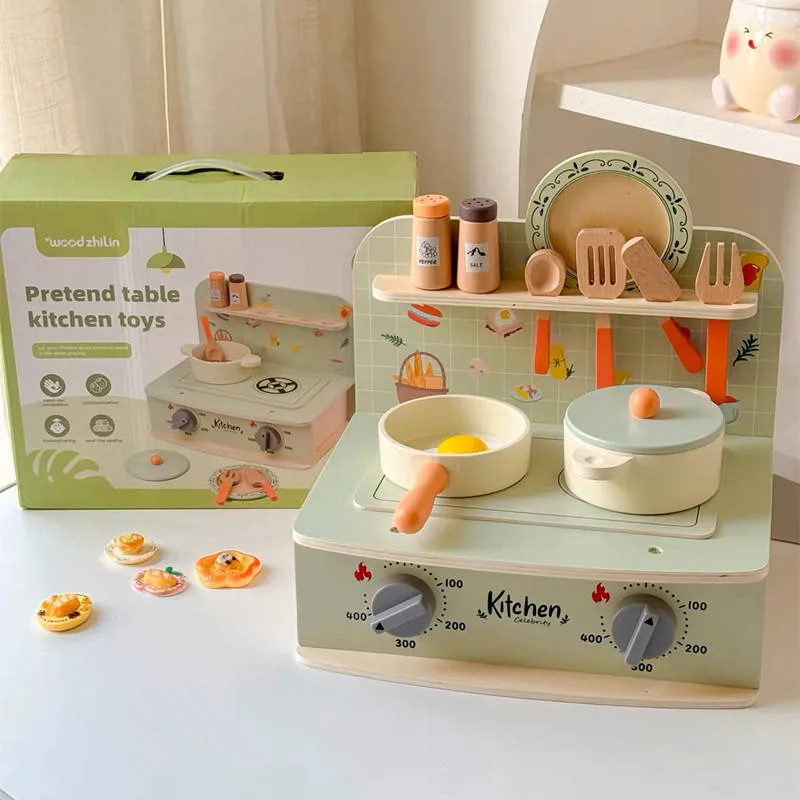
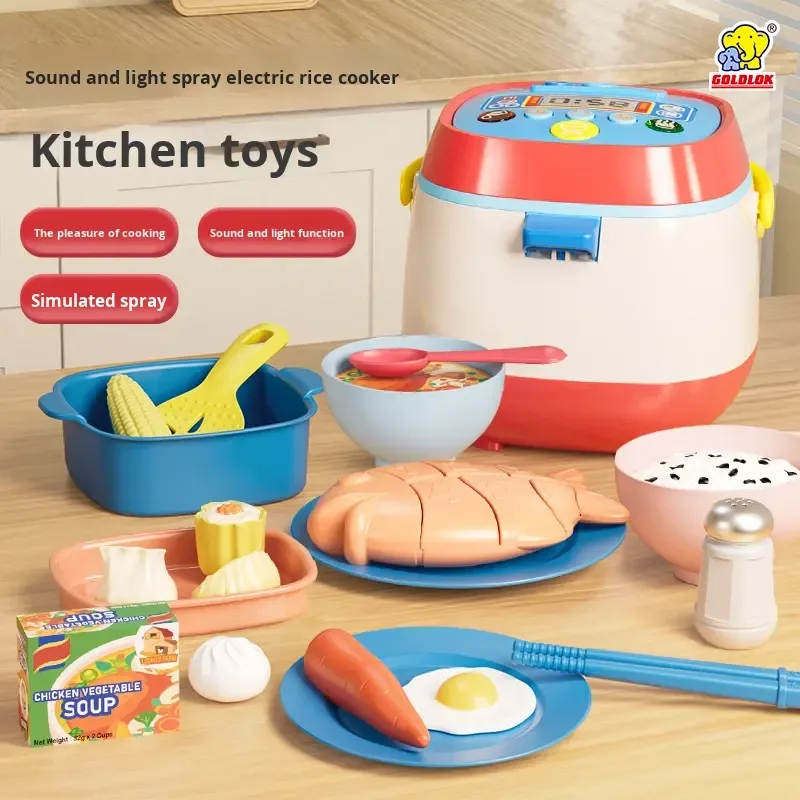
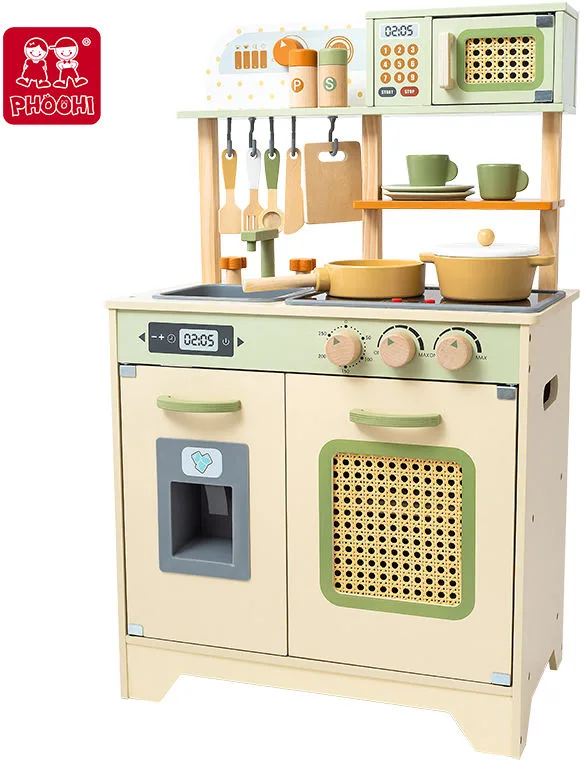
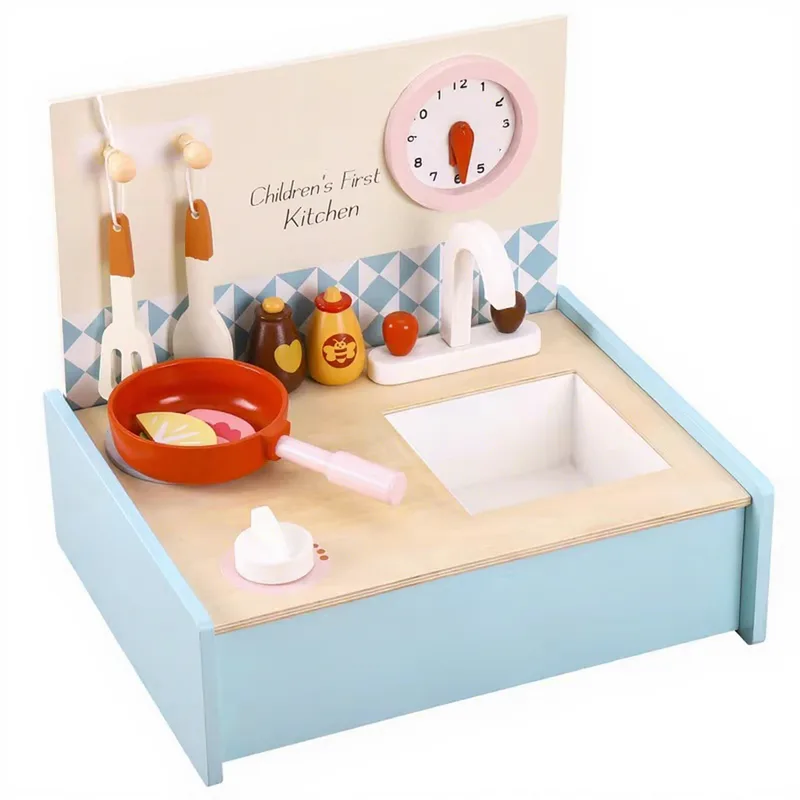
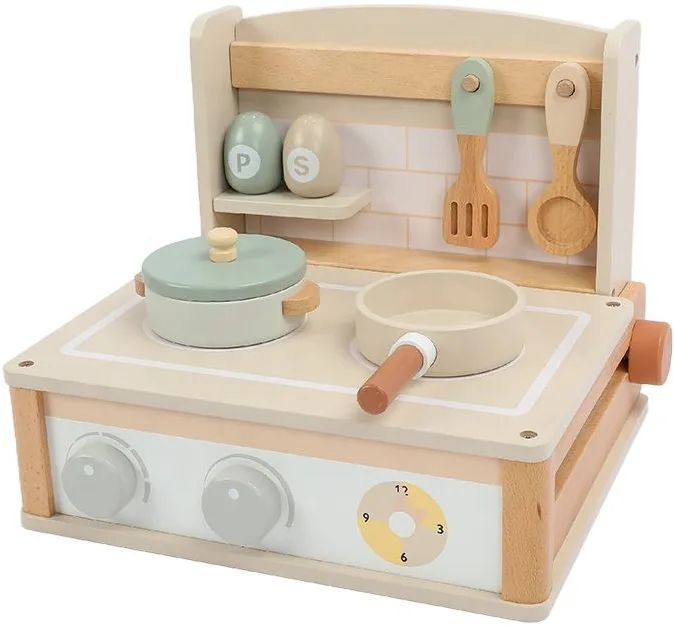
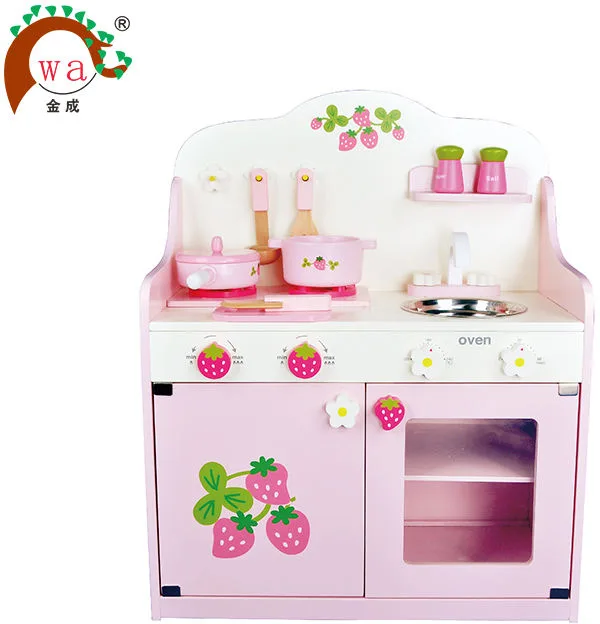
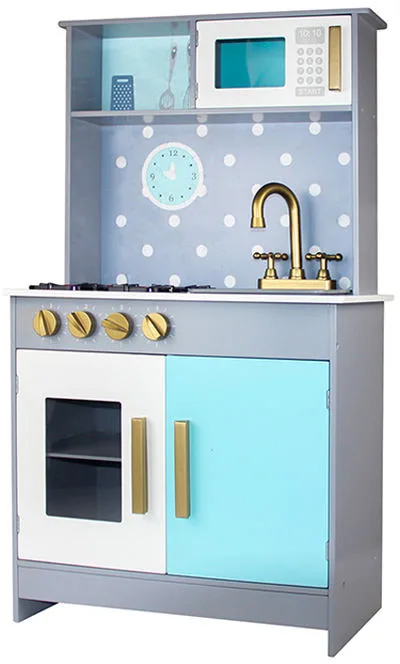
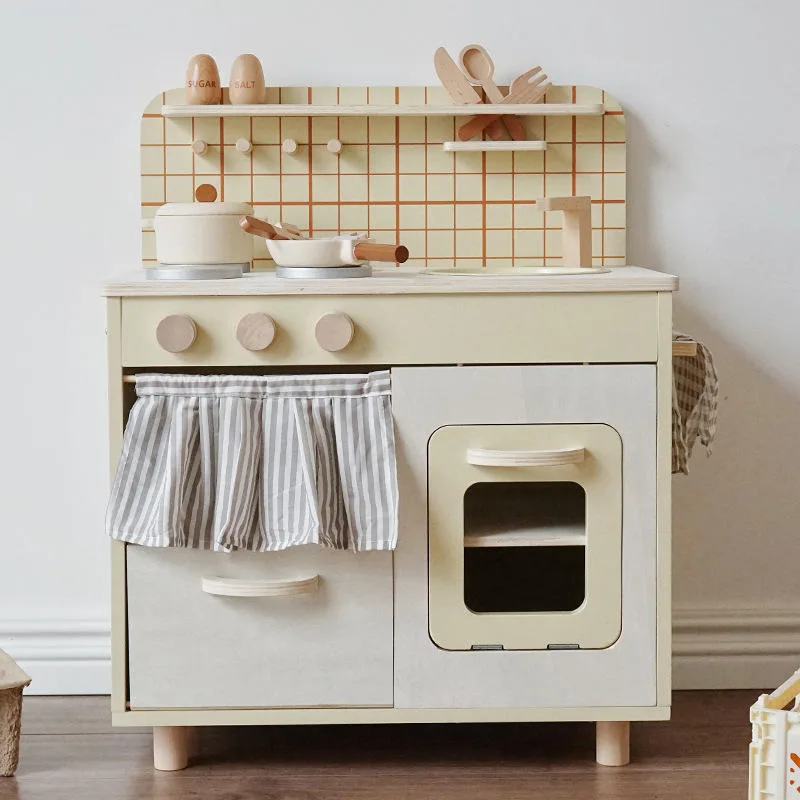
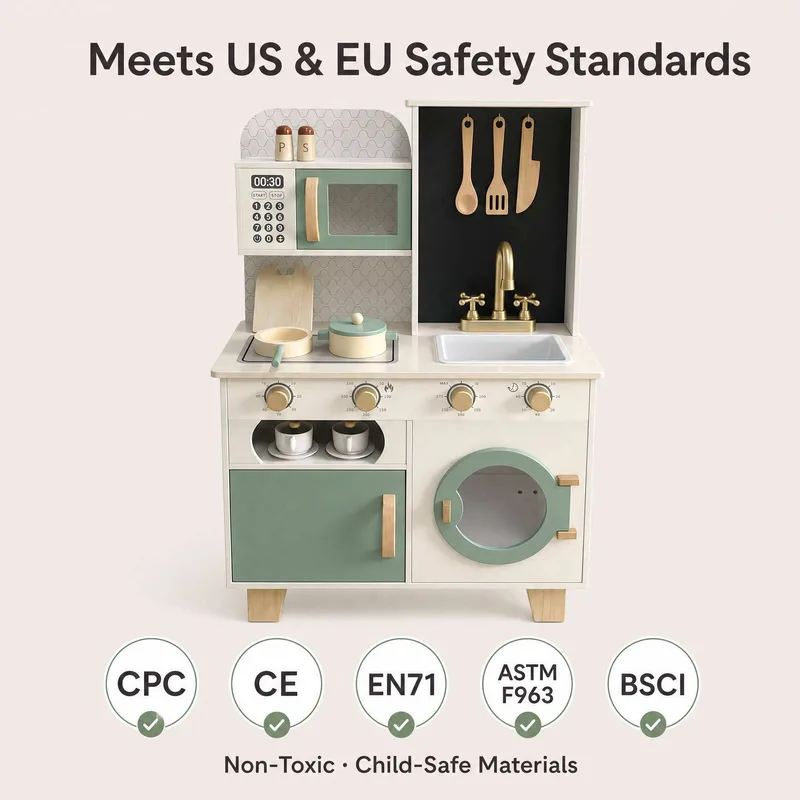
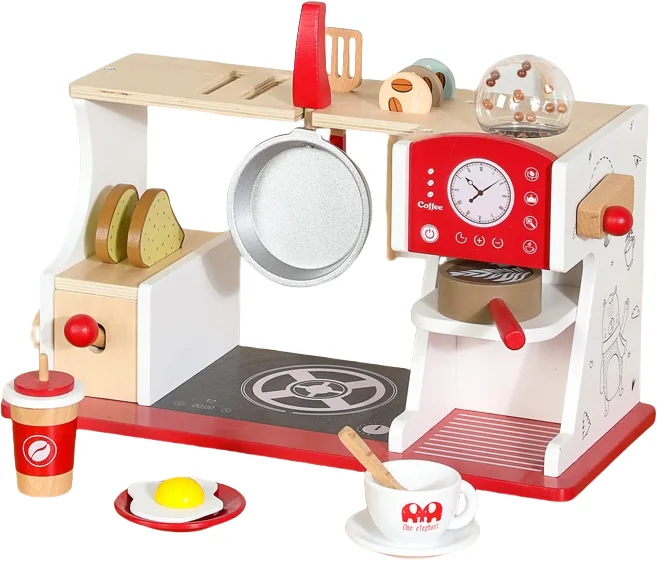
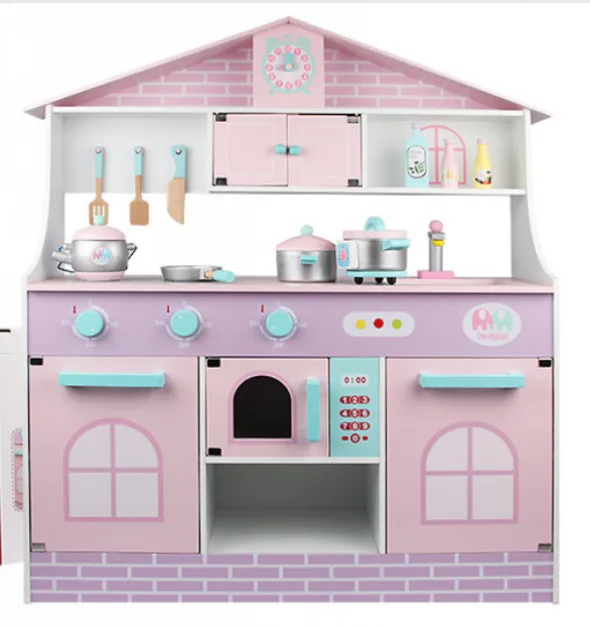
A compact wooden play kitchen is defined by its working height, not by its styling. If the overall height stays under 60 cm (23.6 in), the model belongs in this format: a tabletop hob, a low one-piece kitchen, or a small floor unit for a bedroom corner. The buyers who get this format wrong usually order a tabletop model for a nursery floor, where it tips, or a floor model for a table that is already crowded. The fix is arithmetic — table height, footprint, carton, and weight — before the sample stage.
Where the compact format stops and starts
The practical cut is 60 cm (23.6 in) overall height, because that is roughly counter height for a seated three-year-old and the point where a model stops being portable. Below that line, three sub-types appear: tabletop kitchens that sit on an existing table or low shelf, floor-standing low kitchens with a plinth, and suitcase or carry-handle styles that fold or latch closed.
The format is also the most likely to be sold as a gift, a nursery add-on, or a second kitchen for a grandparent's house. That changes the specification work: carton proportions and assembled stability matter more than storage depth, and a model that needs a screwdriver for every joint is a poor fit for the gift channel while being fine for a preschool.
Compact models are often the entry point into the catalogue, with the full-height complete kitchens used as the anchor SKU for display.
How to choose the compact model
Begin with the surface it will live on. A tabletop unit needs a table at least as wide as the model plus 10 cm (3.9 in) on each side, and the child needs to stand or sit at a comfortable height; if the table is 55 cm (21.7 in) high, a 25 cm (9.8 in) tall hob lands near the right working height. A floor unit needs a plinth and a wall or corner so it cannot slide.
Age narrows the choice. Two- and three-year-olds are usually seated or kneeling, so a 45–55 cm (17.7–21.7 in) worktop with a shallow 22–28 cm (8.7–11.0 in) body works. Five- and six-year-olds are already outgrowing the format; the 60 cm vs 80 cm page shows where the step up pays off.
Lights and sound are worth a deliberate decision here, because compact units carry them well: the module sits close to the child's hands, and a small carton absorbs the battery compartment without a packaging redesign. The lights and sound comparison covers the packing and test-scope consequences.
Dimensions and footprint
Compact models are quoted by overall height first, then width, then depth. The footprint is small, but the stability envelope is not: a 50 cm (19.7 in) tall unit with a 26 cm (10.2 in) deep body has a narrow base, so the plinth width and any wall anchor become part of the specification.
| Specification | Typical range (cm) | Typical range (in) | Confirm with the supplier |
|---|---|---|---|
| Overall height | 35–59 | 13.8–23.2 | Top of backsplash or hob |
| Worktop height | 35–55 | 13.8–21.7 | Tabletop or floor-standing |
| Body width | 40–75 | 15.7–29.5 | Outer carcass, knobs excluded |
| Body depth | 22–35 | 8.7–13.8 | Body only, tap excluded |
| Footprint | 40 × 22 to 75 × 35 | 15.7 × 8.7 to 29.5 × 13.8 | Width × depth |
| Gross weight | 3–8 kg | 6.6–17.6 lb | Per carton, typical |
Every figure is typical and confirmed per model. Compact units are the format most often measured from a listing photo, so check the dimensions data page and the dimensions guide for the baseline numbers before accepting a stated width.
Packing, CBM, and MOQ
Small cartons are the reason this format loads so well. A tabletop kitchen in a carton of 62 × 38 × 14 cm (24.4 × 15.0 × 5.5 in) works out at 0.033 CBM, so a 20GP planning figure of about 28 CBM holds roughly 800 cartons, volume permitting; that is roughly twice the carton count of a full-size flat-pack at 0.07 CBM. Gross weight, not volume, can become the limit on tabletop styles packed two or three per carton, so confirm carton quantity.
Because the carton is small, this is the format that most often meets parcel-network rules: longest side under 60 cm (23.6 in) and a compact girth keep a unit inside standard handling where a full-size carton would be treated as bulky. The CBM and loading guide works through the arithmetic if you are planning a mixed container.
MOQ follows the low-volume reality of the format. Typical bands start around 100 pcs per colour for tabletop models, with lower quantities on stock colours or unprinted cartons. Lead time is typically 25–45 days from sample confirmation for simple models, longer if lights and sound are added. Both figures are confirmed per model in the quotation.
Common misjudgments
- Treating "compact" as a size label for a full-height kitchen with a smaller footprint. Check the overall height first.
- Putting a tabletop unit on a shelf where the child has to reach up, which makes the whole assembly unstable.
- Comparing carton CBM without comparing carton quantity — two units per carton halves the effective carton count.
- Assuming a small carton is automatically parcel-safe. Girth and weight decide that, not length alone.
- Skipping the plinth or wall anchor on a floor-standing low unit.
- Buying the format for a five-year-old because it fits a shelf, then finding the counter is too low to play at.
A compact wooden play kitchen is the easiest format to load and the easiest to mis-specify. Confirm overall height, worktop height, footprint, carton size, carton quantity, and gross weight in writing; then compare the result against the surface the unit will actually stand on. Send the table or room dimensions with the quote request so the answer can be a fit answer.