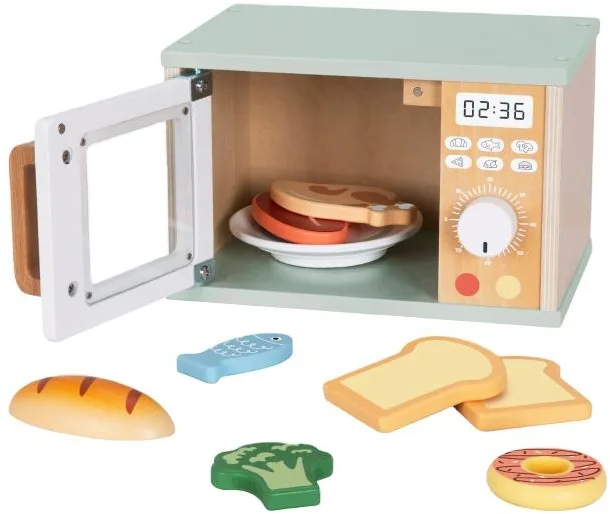
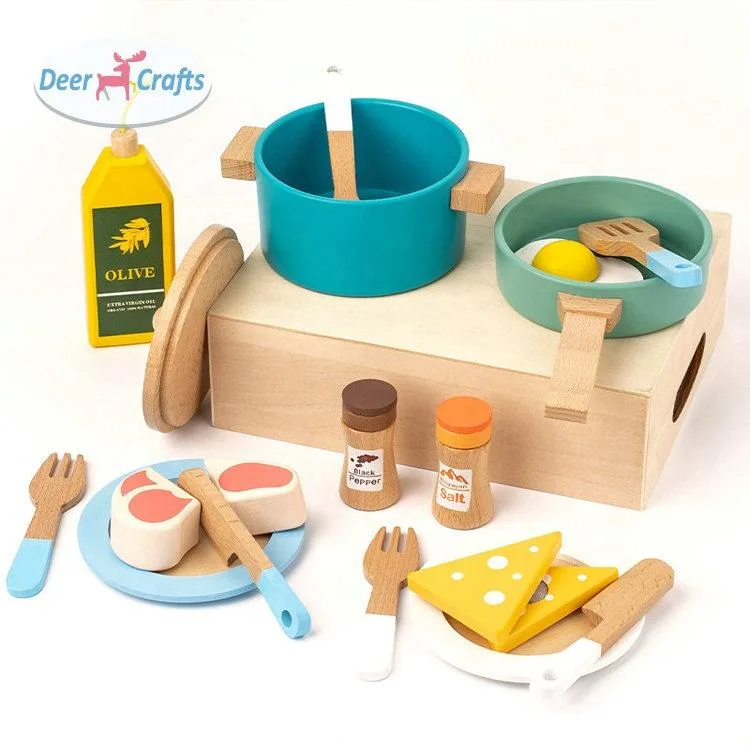
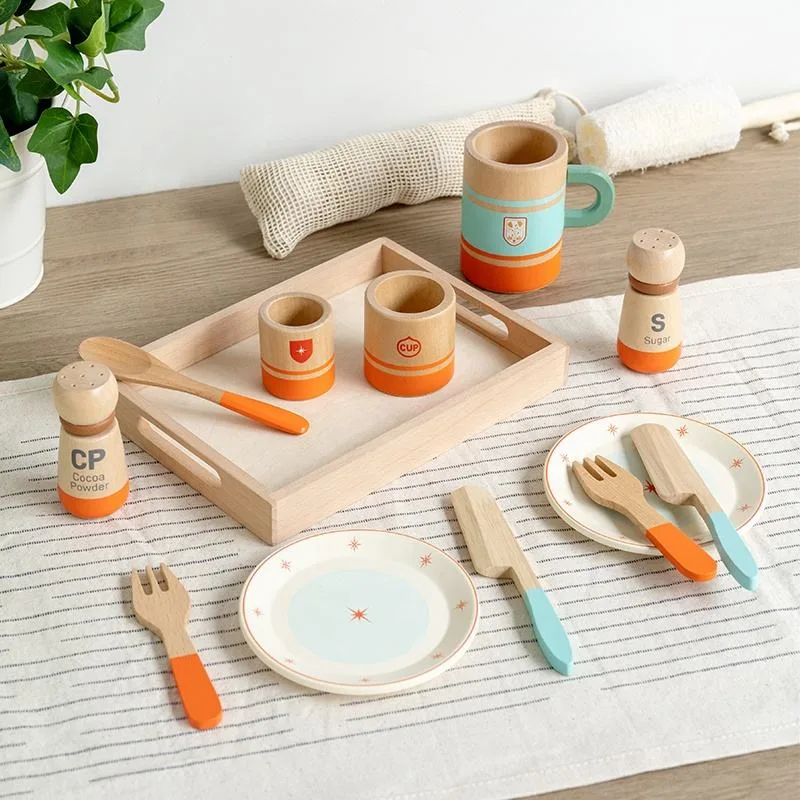
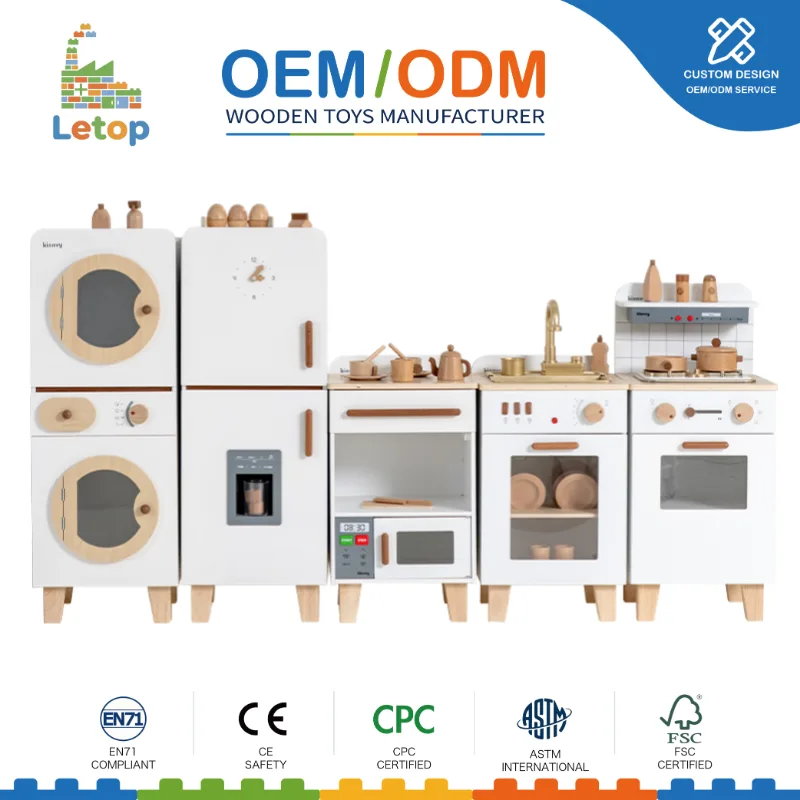
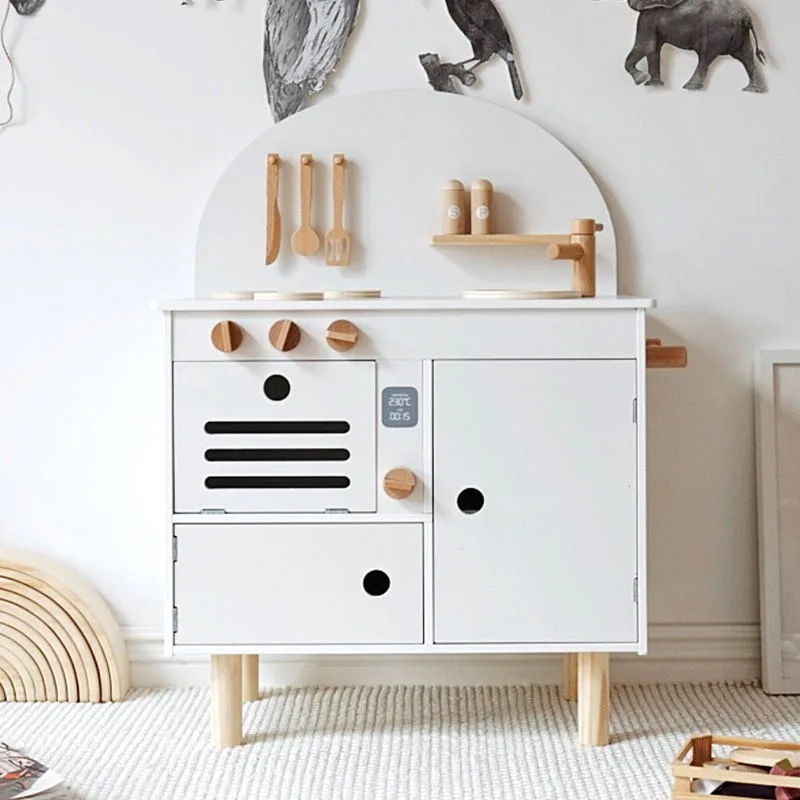
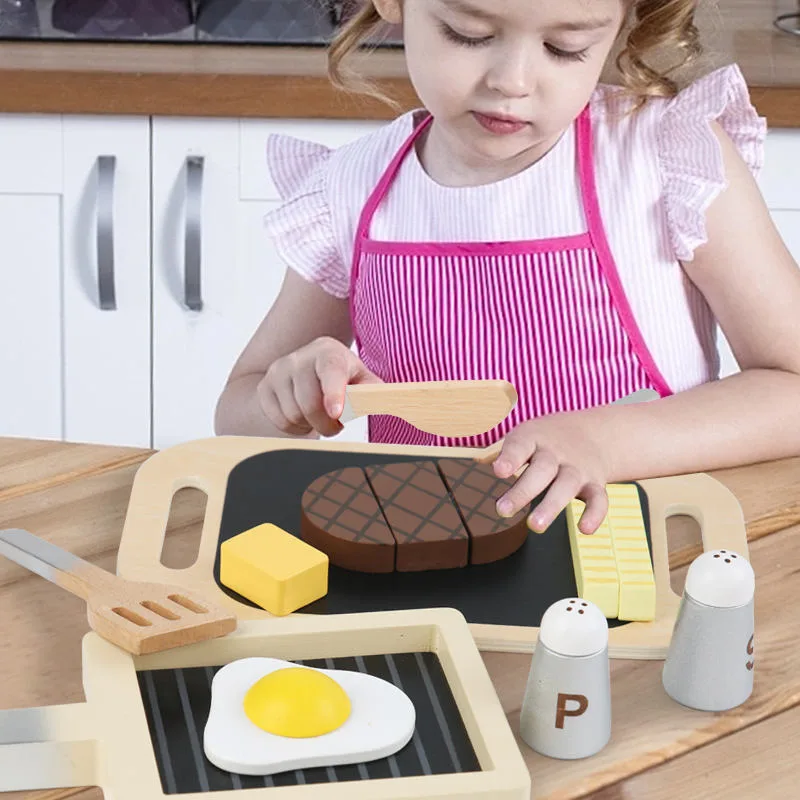
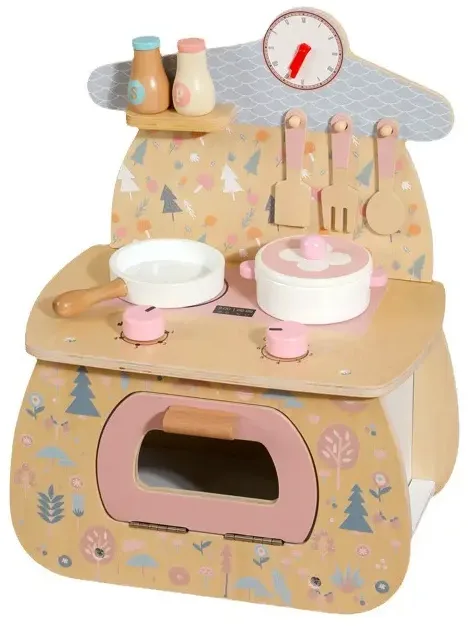
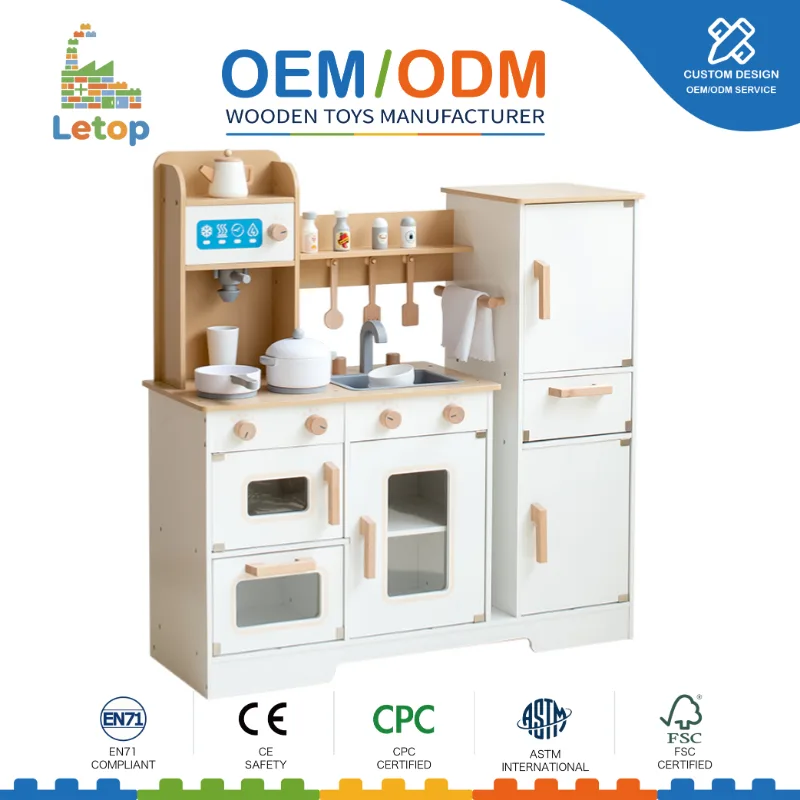
Wooden play cookware is the accessory line that decides whether a kitchen can be played with on the first day. Pots, pans, lids, utensils, plates, and tea or coffee pieces are usually sold as sets of 8 to 30 pieces, boxed smaller than any other format. The specification work is piece count, diameter, and carton: a set that does not fit the hob it was bought for, or that ships in a carton too shallow for its own lid, will be returned on the first order.
What the cookware format contains
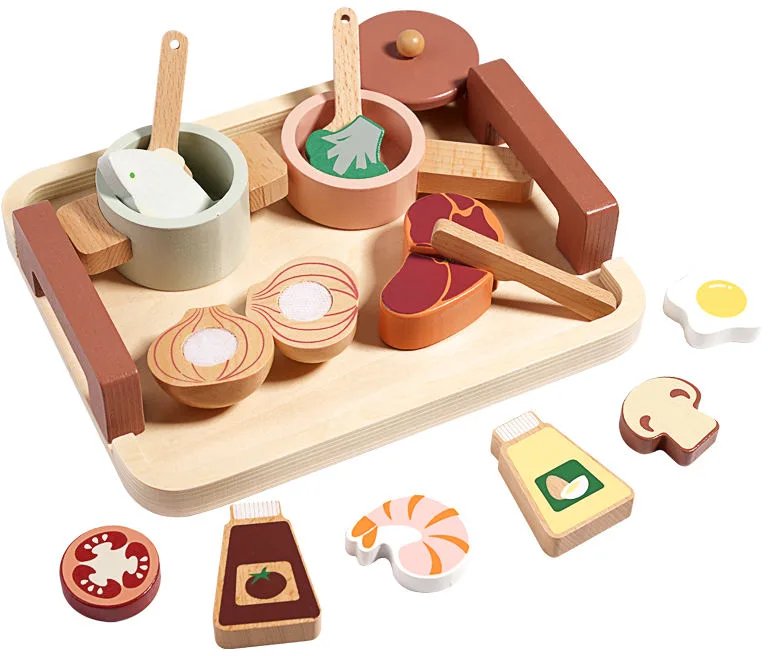
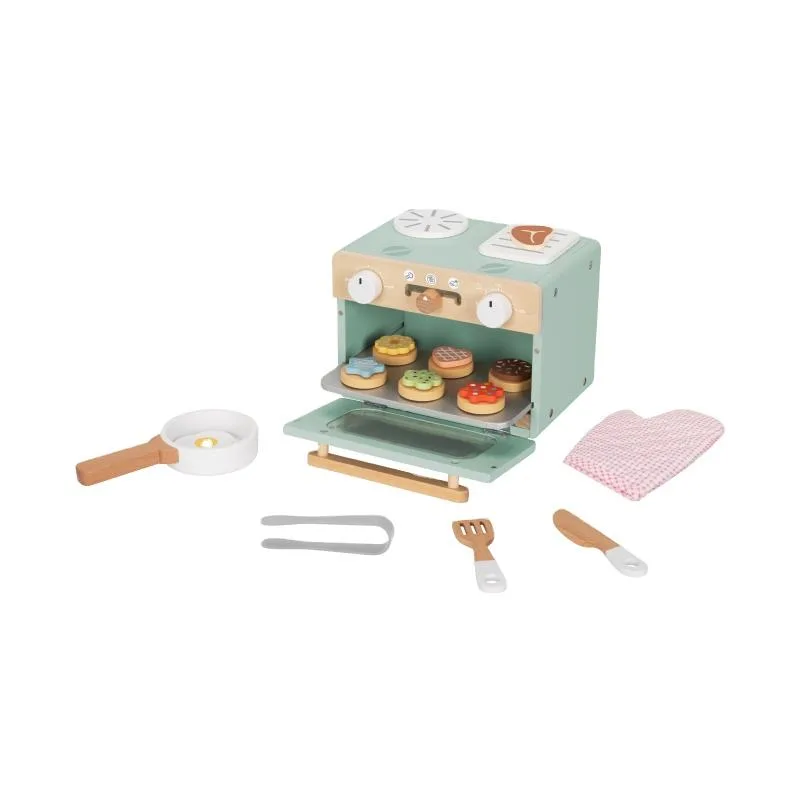
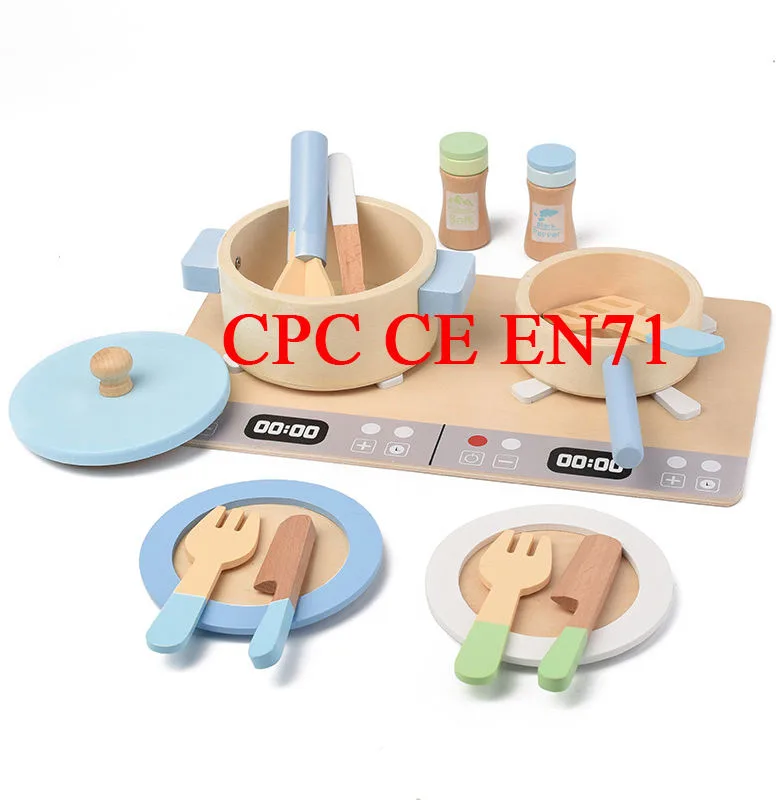
The category covers four groups. Cook pots and pans, usually with lids. Utensils: spoons, spatulas, ladles, tongs, knives. Tableware: plates, bowls, cups, mugs, saucers. And drink sets: tea or coffee sets with a pot, cups, and a tray. Some ranges also include a cutting board and a play knife, though those are often catalogued with play food.
Sets are the unit of sale, not single pieces, because a 6-piece pot set has a clear gifting shape and a clear carton. Piece counts are usually stated on the box, so the piece count is a specification you can verify: open a sample and count, because a set described as 12 pieces is sometimes 10 pieces plus two lids that were counted separately.
Materials matter less than construction. Solid wood, plywood, and painted MDF all appear in the format; what buyers should check is wall thickness, how the lid seats, whether handles are glued, screwed, or a single turned piece, and whether painted edges are sealed. Those four details decide how a set survives a preschool year.
How to choose the cookware set
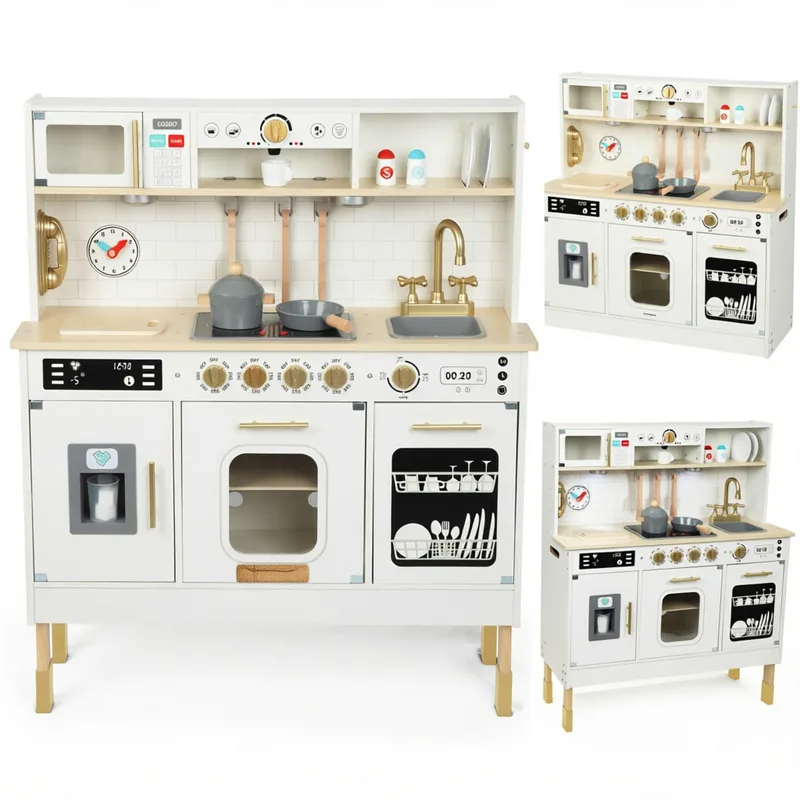
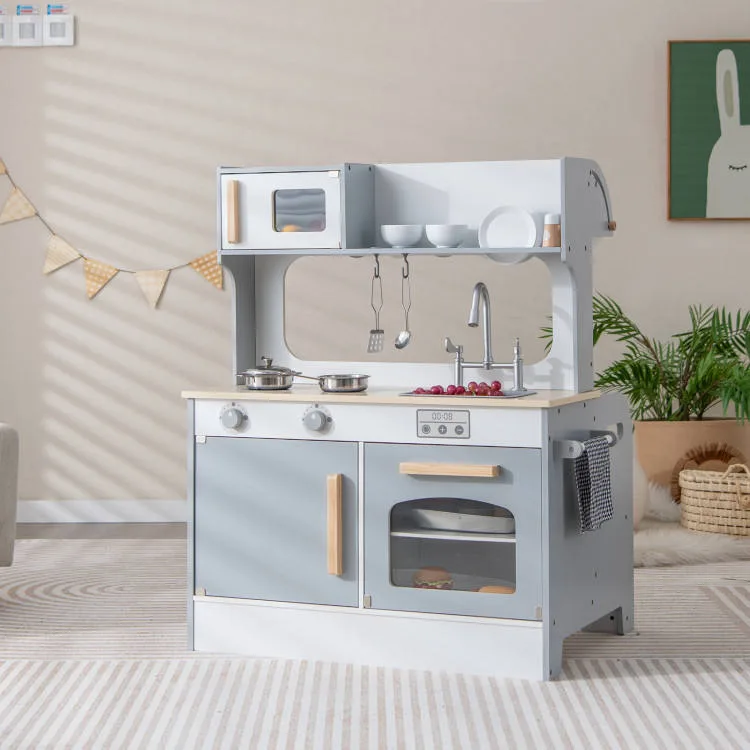
Start with the hob. Pots need to sit flat on the hob rings or burners, so a set whose largest pot is 16 cm (6.3 in) across will overhang a small kitchen with 10 cm (3.9 in) rings. Ask for the hob ring diameter and the pot diameters in the same reply.
Then choose by channel. Gift and home channels do well with 8–12 piece sets in a printed box, because the set reads as a complete present. Preschool and education channels want larger counts and duplicates of the pieces that wear first, usually spoons, plates, and lids; the accessories checklist lists the duplicates worth ordering. Retail display usually needs a set that stands upright in a box, which is a carton-format decision as much as a product one.
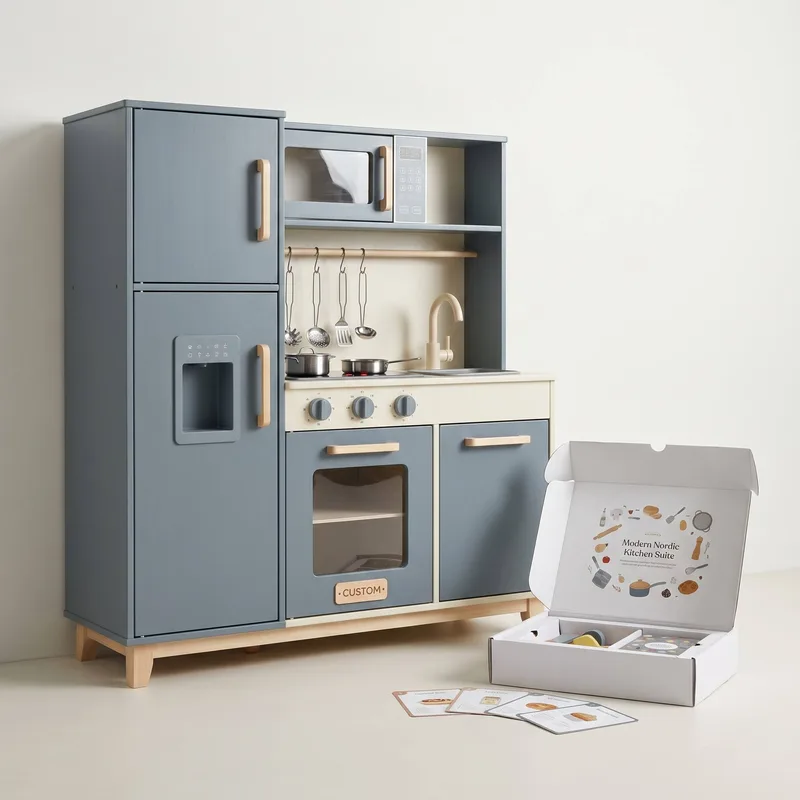
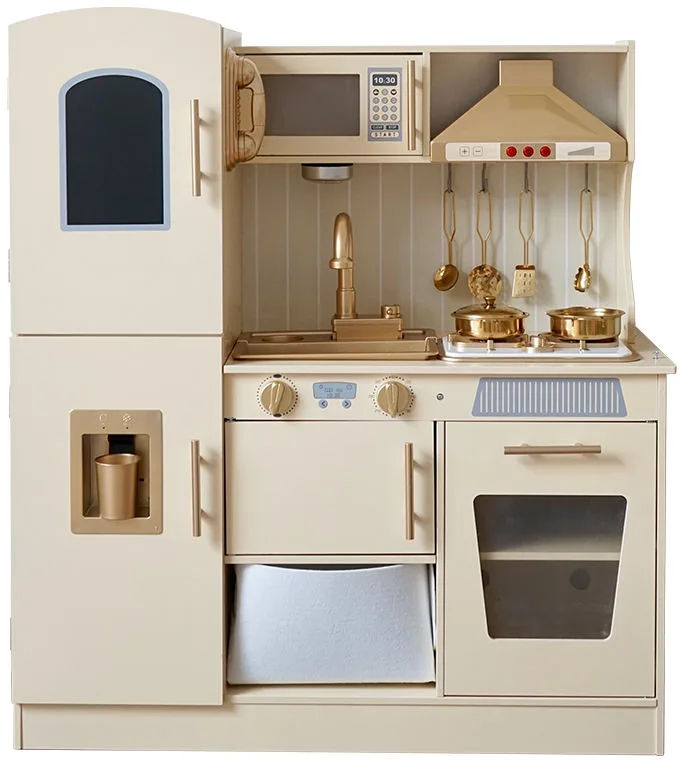
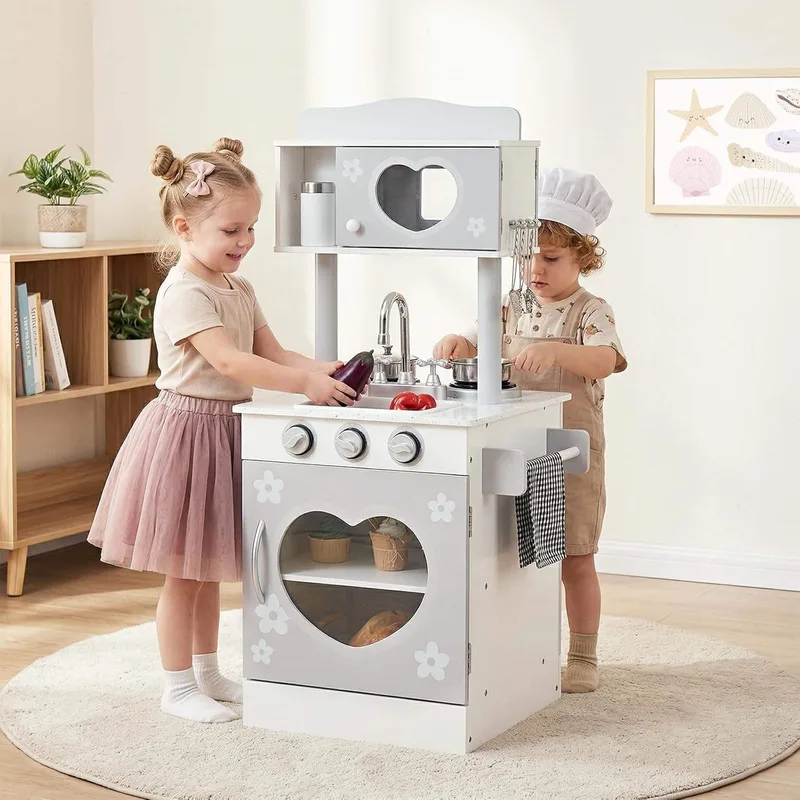
Size follows the play kitchen height. A 50 cm (19.7 in) worktop is comfortable with 10–14 cm (3.9–5.5 in) pots and 18 cm (7.1 in) utensils; a 60 cm (23.6 in) worktop lets a child use a 16 cm (6.3 in) pan without lifting it awkwardly. If the kitchen is the taller format, scale the cookware only after the worktop height is confirmed in writing.
Dimensions and footprint
Cookware is quoted by piece count, largest piece, and set weight. There is no footprint in the kitchen sense, but there is a storage question: where the set lives when it is not being played with, and whether the kitchen's cupboard can hold it.
| Specification | Typical range (cm) | Typical range (in) | Confirm with the supplier |
|---|---|---|---|
| Pot diameter | 8–16 | 3.1–6.3 | Largest piece decides hob fit |
| Pan diameter | 12–20 | 4.7–7.9 | Handle length added separately |
| Utensil length | 12–22 | 4.7–8.7 | Shorter for under-3s |
| Piece count per set | 8–30 | — | Count lids and handles |
| Set gross weight | 0.5–3 kg | 1.1–6.6 lb | Typical per set |
| Carton size | 20–45 × 15–30 × 10–20 | 7.9–17.7 × 5.9–11.8 × 3.9–7.9 | Per set, typical |
All figures are typical and confirmed per model. The dimensions data page carries measured kitchen baselines, which is what the pots have to match.
Packing, CBM, and MOQ
Cookware loads well because the cartons are small: a 12-piece set in a 32 × 22 × 12 cm (12.6 × 8.7 × 4.7 in) box is about 0.008 CBM, so 1,000 sets occupy roughly 8 CBM and a 20GP planning figure of 28 CBM absorbs thousands. The constraint moves to weight, pallet stacking, and retail box quality rather than container volume.
Packing style is the real MOQ lever. A printed retail box, a plain brown box, or a polybag with a header card each set different minimums, and the printed box also fixes the carton dimensions. If the same set is sold in two channels, ask whether the carton is designed for both, or whether one channel needs a mailer.
MOQ for cookware is typically higher than for kitchens because the pieces are inexpensive to produce and low in freight: bands commonly run 200–500 sets per colourway, and mixed-colour sets usually need the colour split confirmed in writing. Lead time is typically 25–40 days from sample confirmation.
The format is also the most common replenishment and spare-parts order, since utensils and lids are the first pieces to be lost; the maintenance and spare parts page explains how to plan that line, and the accessories and spare parts guide sets out the packaging and labelling.
Common misjudgments
- Accepting a piece count without counting the sample: lids and handles are often double-counted.
- Ordering pots larger than the hob rings, so nothing sits flat.
- Checking pot diameter but not lid diameter, then finding lids that do not stack in the kitchen cupboard.
- Assuming carton size drives transit damage: retail box quality matters more than how small the carton is.
- Skipping small-parts checks on utensils for under-three channels.
- Treating cookware as an afterthought on a kitchen order, then running out of stock on the pieces that actually get played with.
Wooden play cookware is small, but it carries the first-play experience, so piece count, hob fit, and lid seating deserve a line in every specification sheet. Confirm the piece list, largest pot and pan, utensil lengths, carton size, and set weight in writing, then load the set as part of a mixed container rather than a standalone order; the small-parts test scope for utensils is set out in the safety standards guide. Browse the catalogue or send a set specification through the quote request.