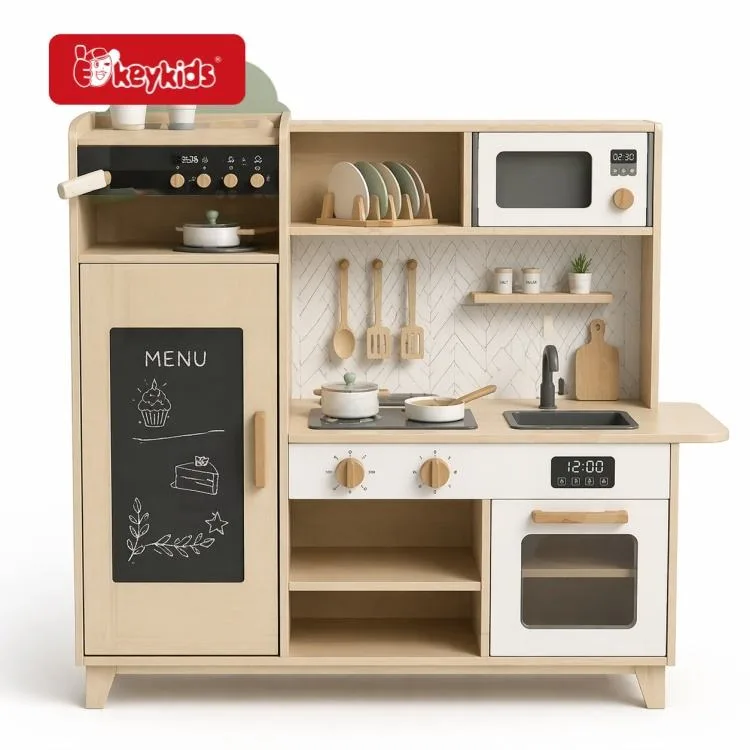
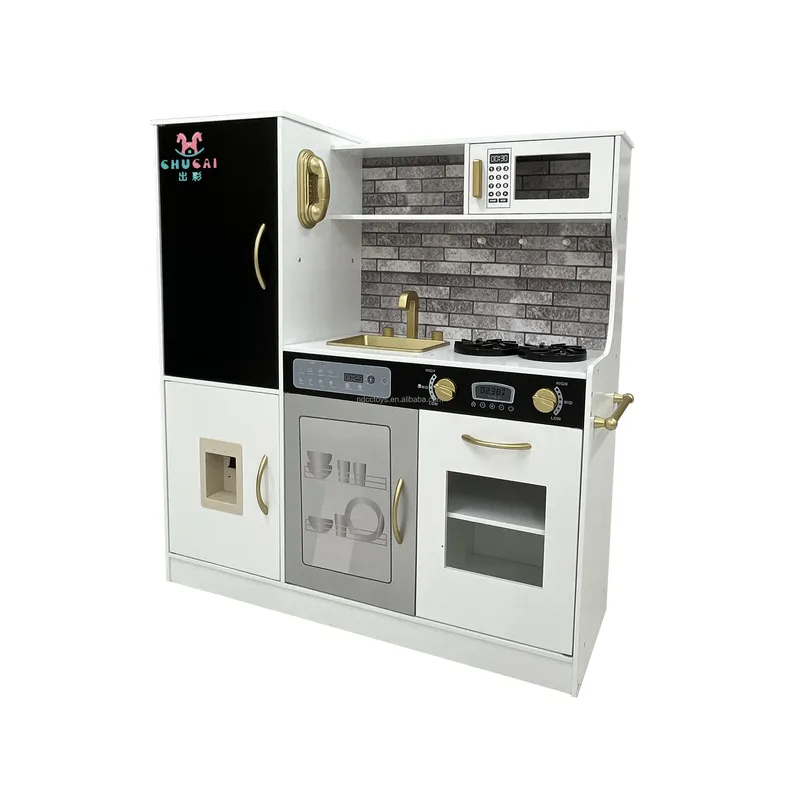
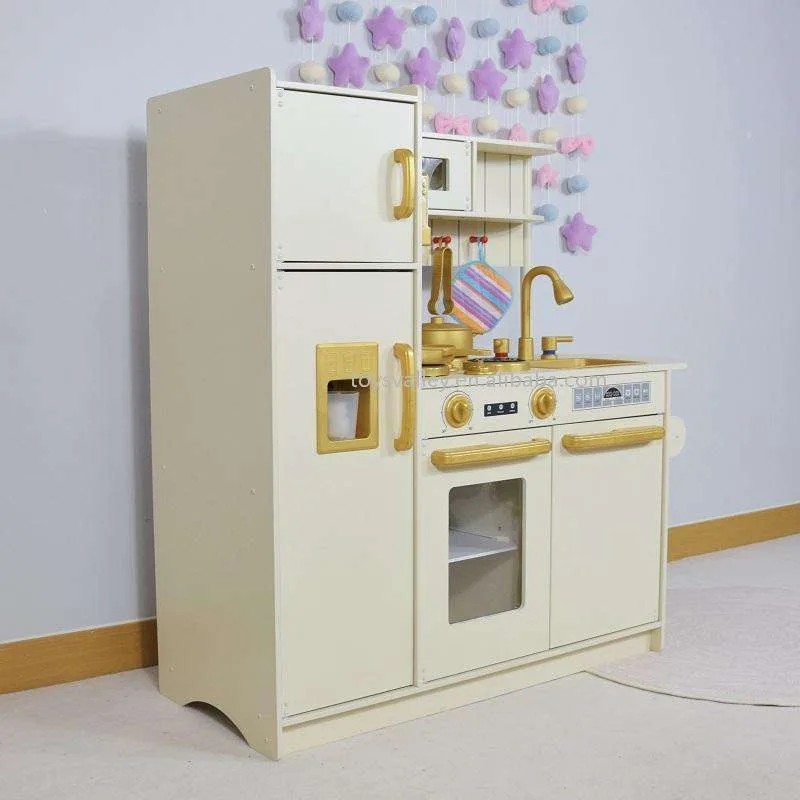
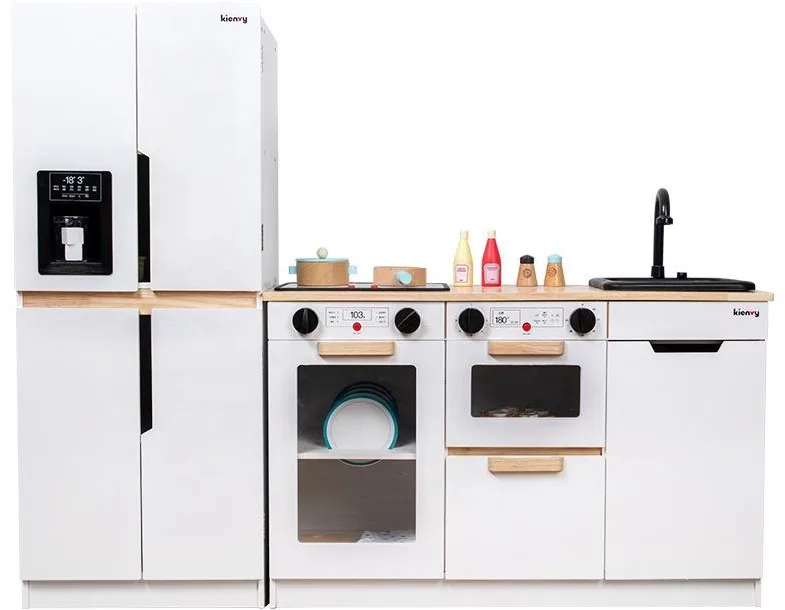
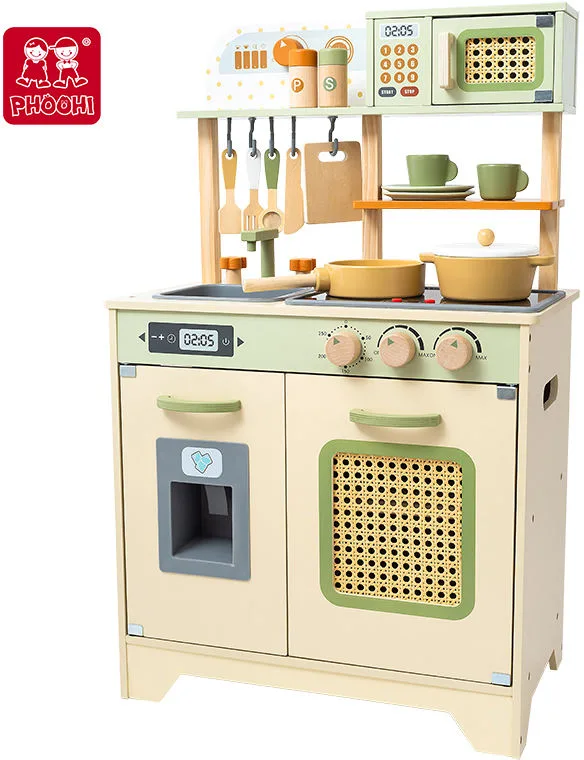
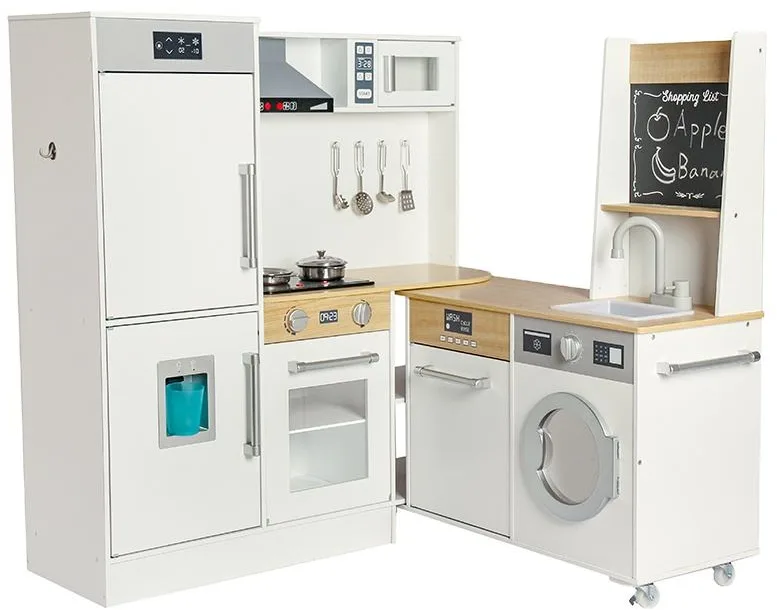
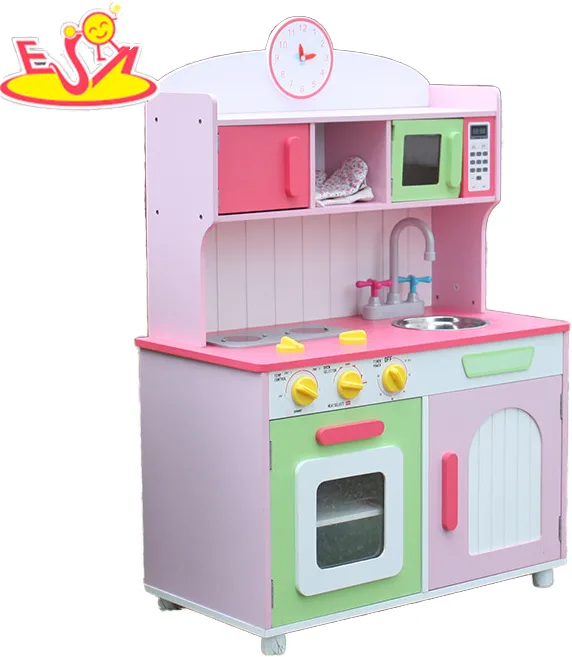
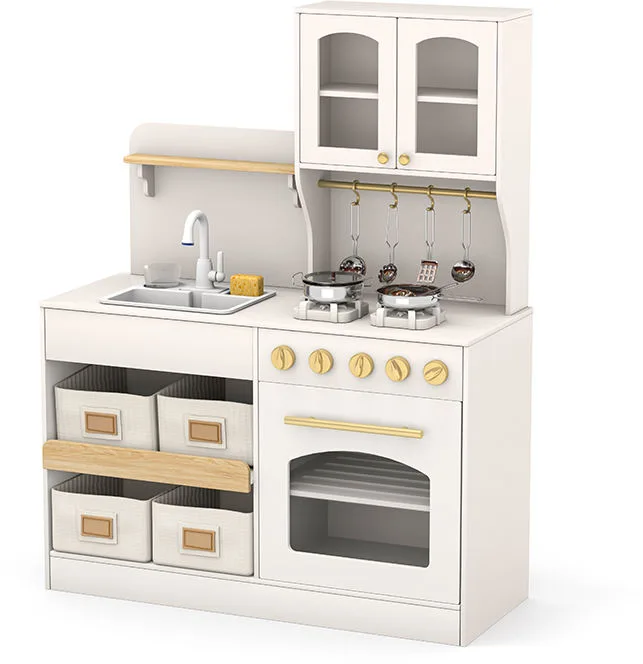
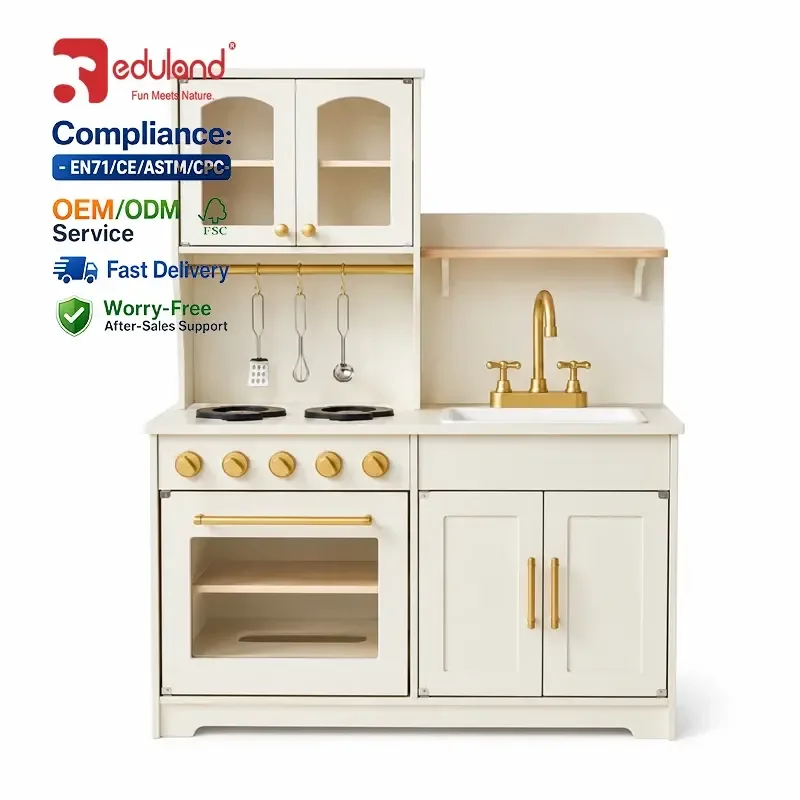
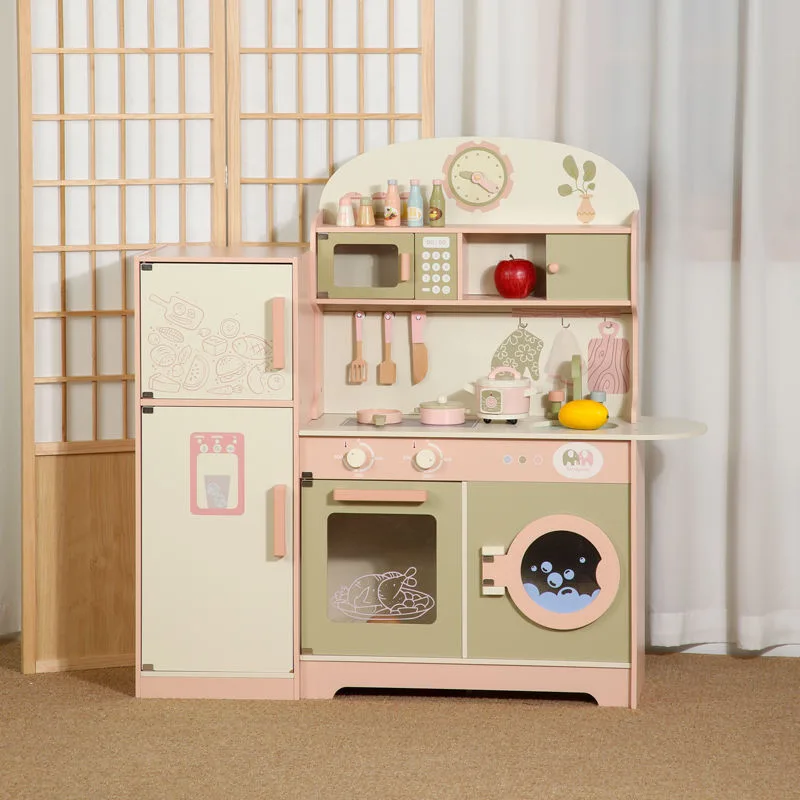
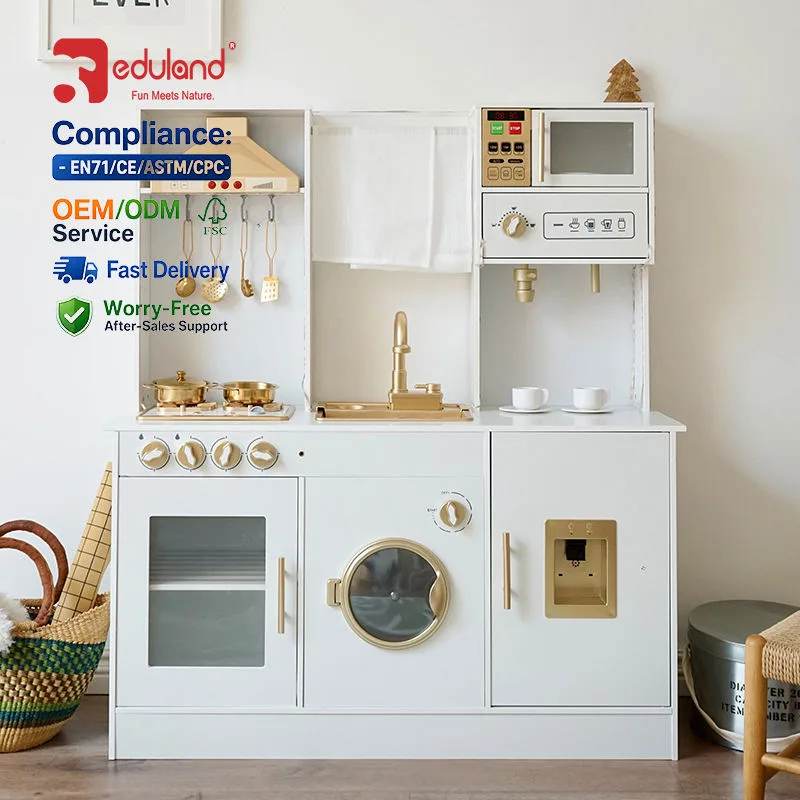
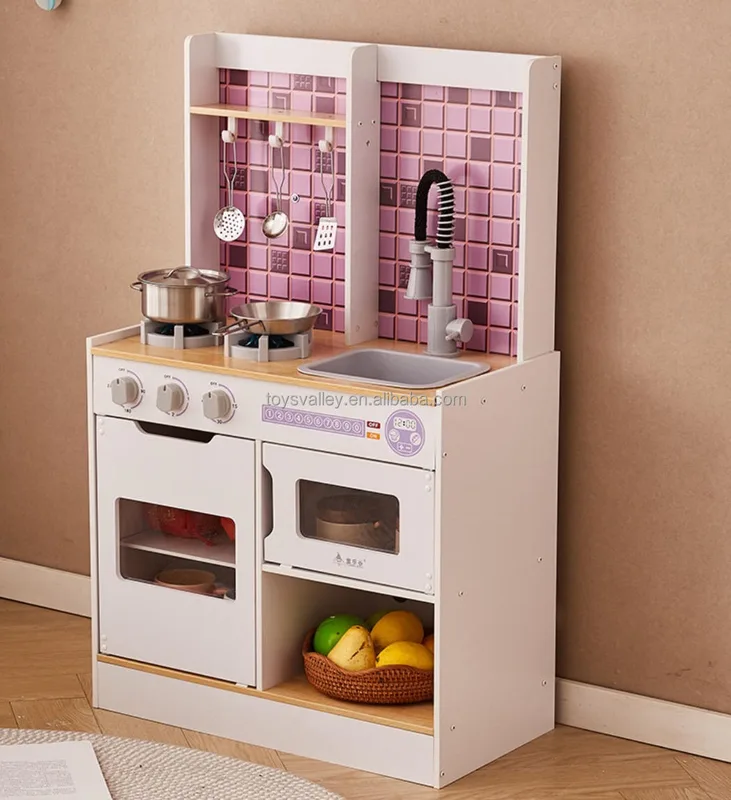
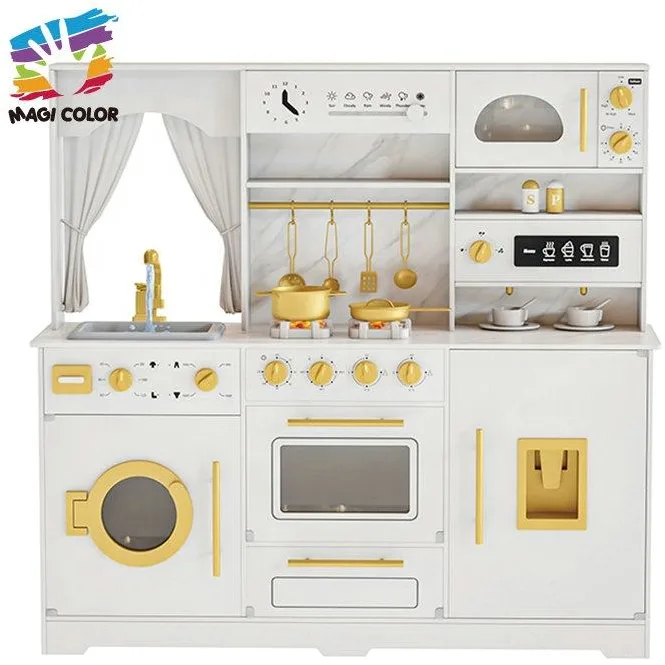
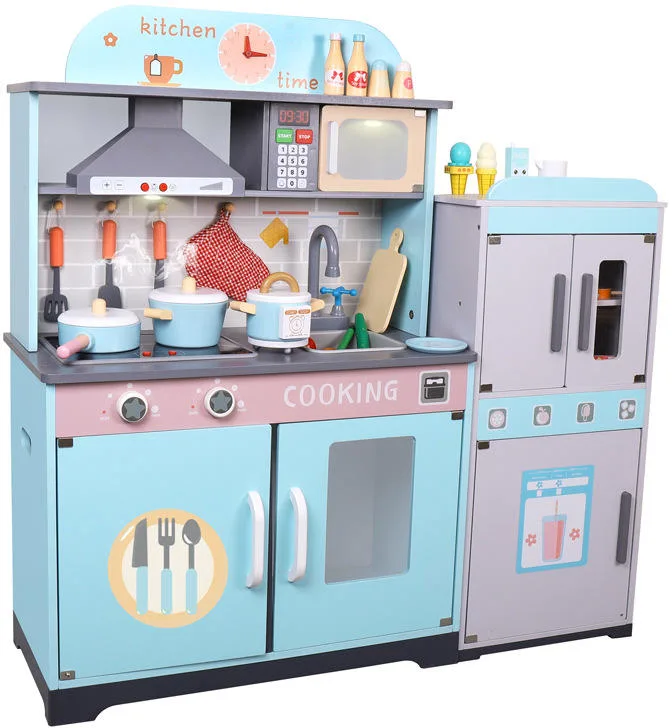
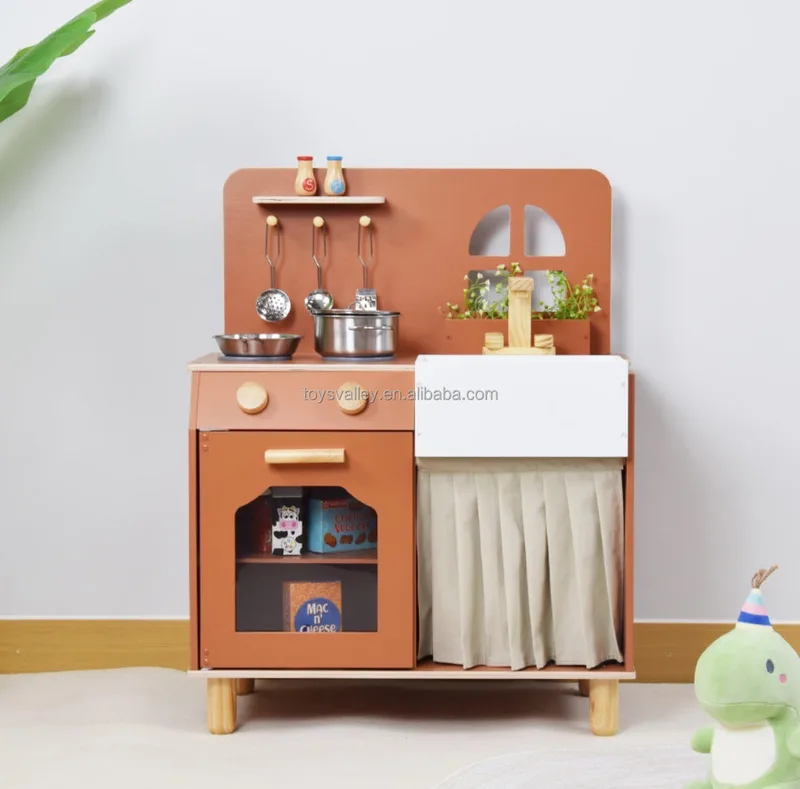
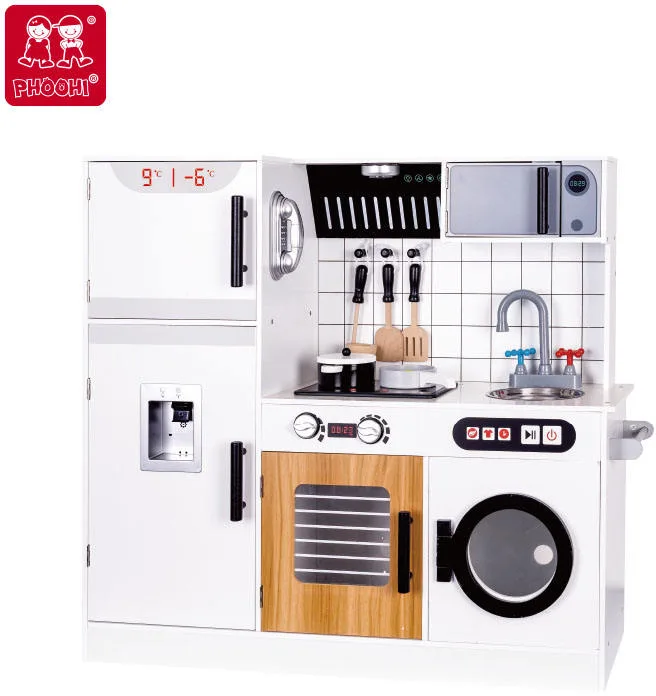
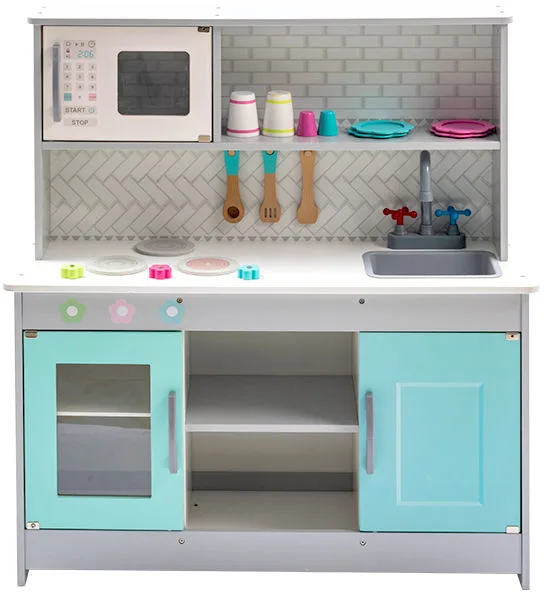
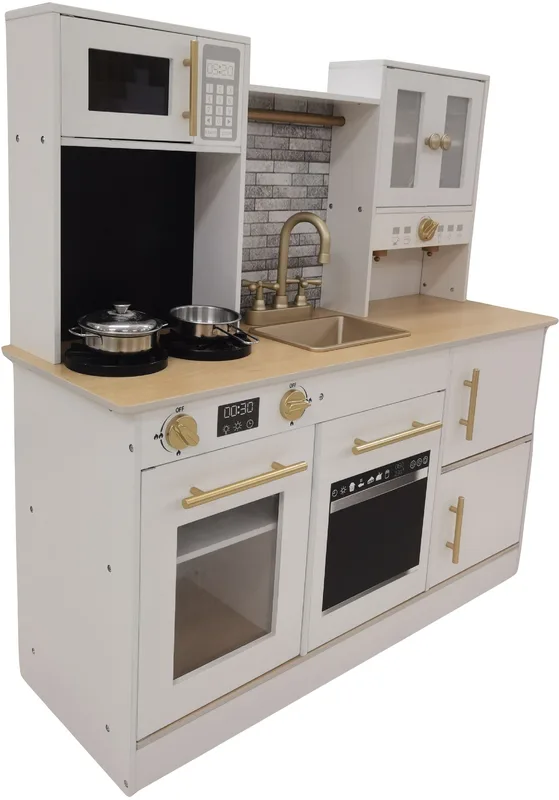
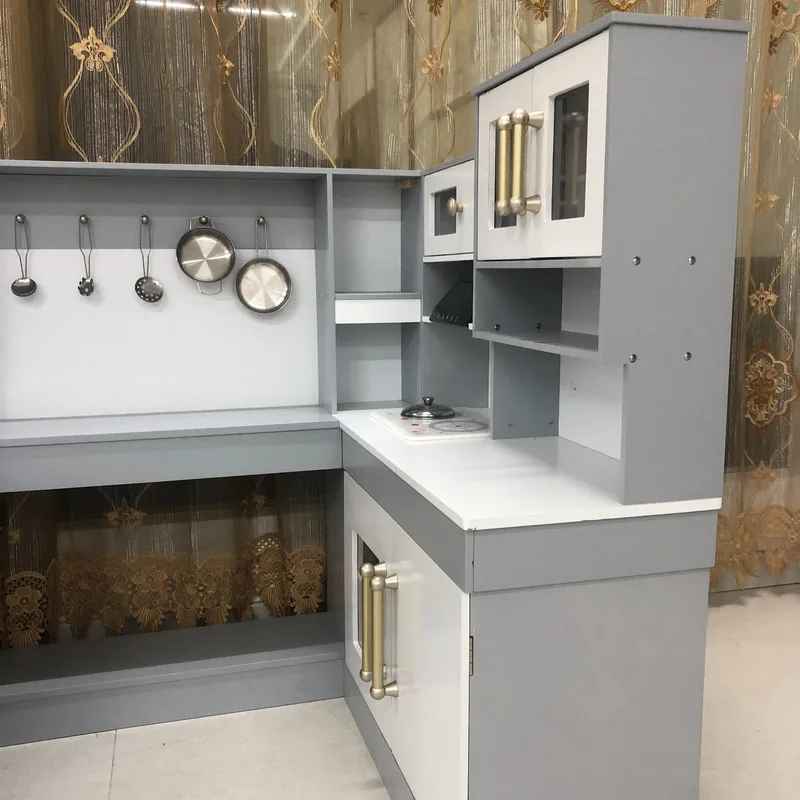
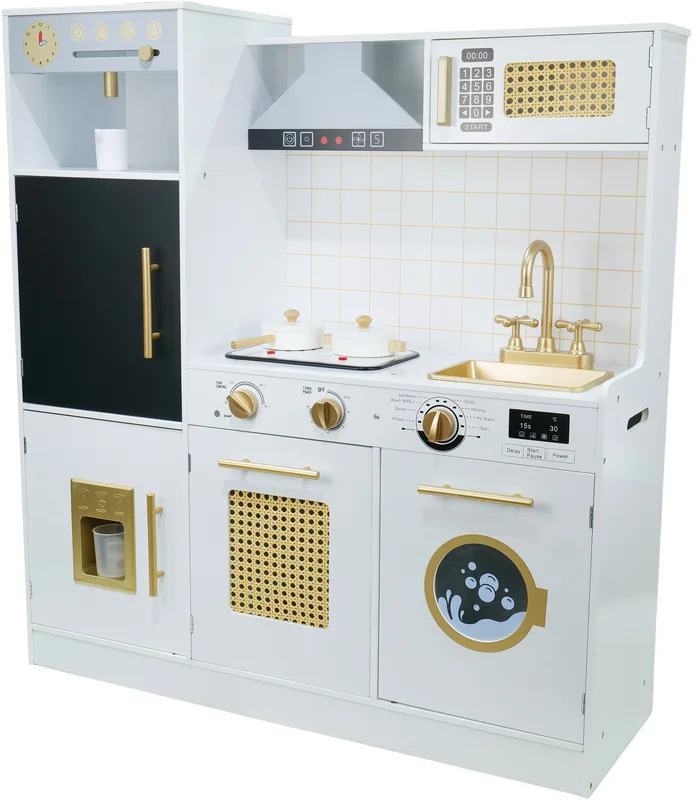
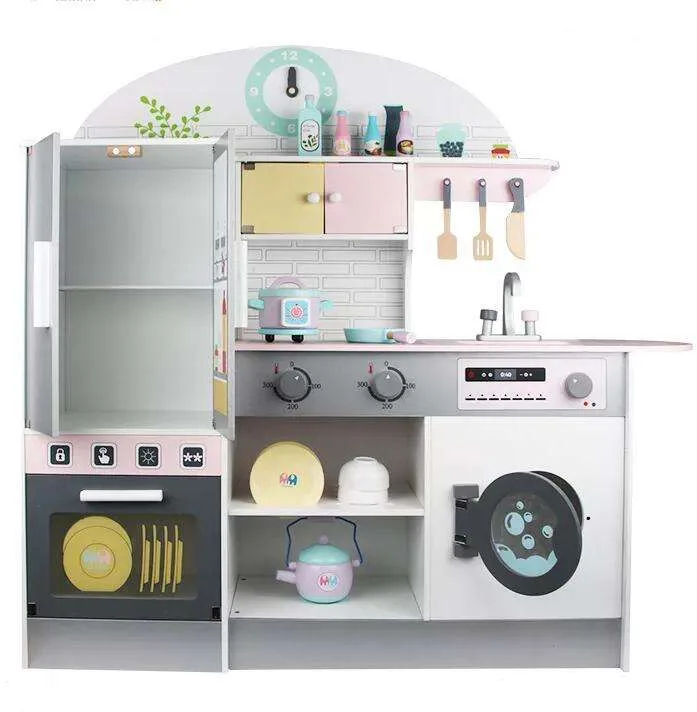
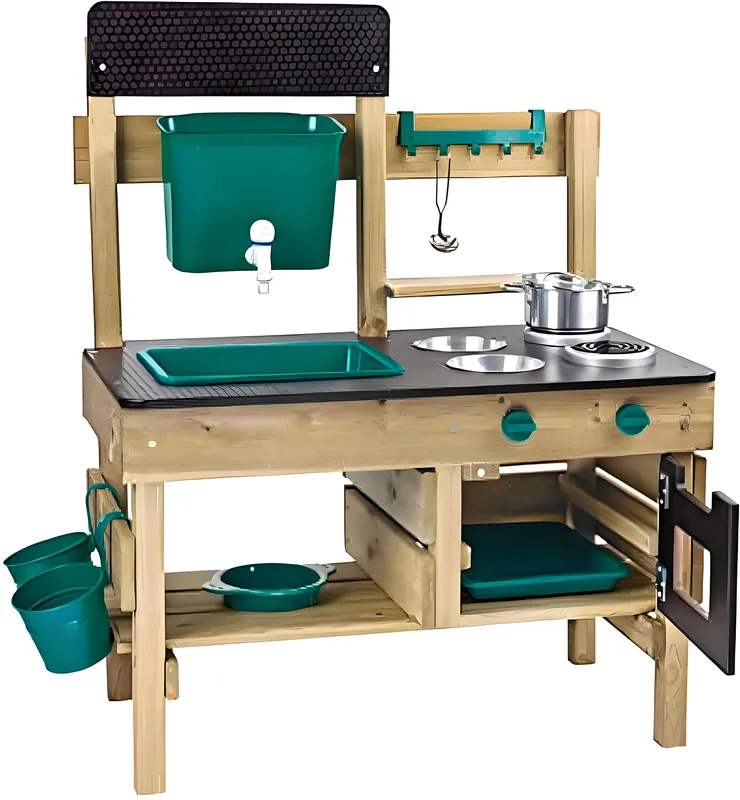
A complete wooden play kitchen is the one-piece freestanding format most buyers picture first: a single carcass carrying a hob, a sink, an oven or cupboard, and usually a back panel with a shelf or hanging rail. Sets the scale for every accessory sold beside it. The specification work is not the styling; it is the set of numbers — worktop height, footprint, carton, CBM, MOQ — that decide whether the model fits your channel before a sample is cut.
What ships as a complete play kitchen
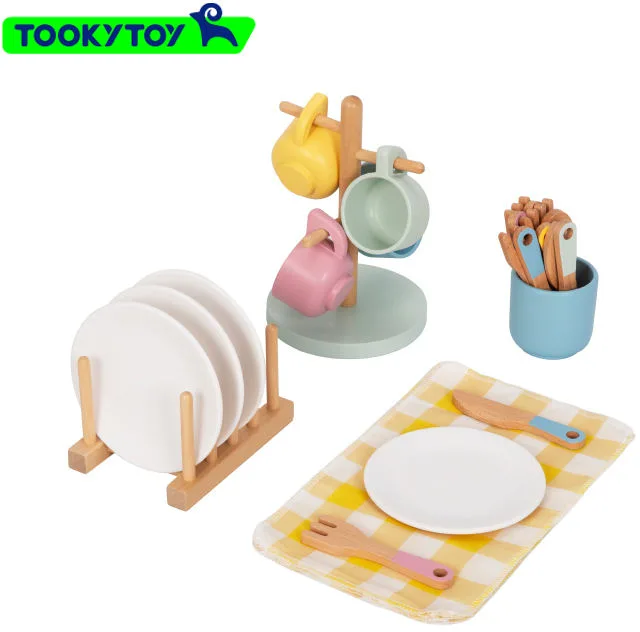
The category means one carton, one standing kitchen. Hob, sink, and at least one storage compartment are fixed; back panels, oven doors, taps, knobs, and chalkboards vary by model. Cookware and play food are separate SKUs in almost every case, so a "complete" kitchen is complete as furniture, not as a play set.
Three build variants share the format, and the variant matters more than the shutter style:
- Flat-pack — panels, hardware bag, printed instructions. Smallest carton per unit, most buyer-side assembly.
- Partially assembled — carcass built, doors and fittings off. A middle carton profile.
- Assembled — arrives standing. Largest carton, highest gross weight, least labour.
Height splits the catalogue. Complete kitchens typically stand 60–100 cm (23.6–39.4 in) overall with the worktop at 50–60 cm (19.7–23.6 in). Anything below 60 cm (23.6 in) overall is usually filed as a compact or tabletop kitchen, and anything built to wrap two walls belongs to the corner format.
How to choose the specification to quote
Start from the channel rather than from the photograph. Specialty toy retail wants a finished unit that can stand on a floor with minimal staff time, which points to partial or full assembly. E-commerce and mail-order channels usually want flat-pack inside a mailer-grade carton, because parcel dimensions and drop performance drive the listing. Distributors and mixed-container buyers care about master carton multiples and whether the carton can be palletised, not about the door style.
Age band decides counter height more than any other input. Counters near 50 cm (19.7 in) suit three- and four-year-olds; 55–60 cm (21.7–23.6 in) suits five- and six-year-olds who play standing. The 60 cm vs 80 cm comparison walks through the footprint and carton consequences of each step up.
Decide single- or double-sided configuration early. A double-sided unit adds panels, changes carton width, and changes what the child sees from the back, so it cannot be treated as a finish option; the single vs double-sided page sets out the trade-offs. Lights and sound modules are a third early decision: they add a battery compartment and a wiring loom, which changes carton protection and the test scope for the model.
Dimensions and footprint
Measure three heights, not one: overall height to the top of the backsplash, worktop height at the front edge, and hob height. Importers routinely compare a 60 cm (23.6 in) worktop model against an 80 cm (31.5 in) overall model and conclude the ranges do not overlap, when the difference is where the tape was placed.
Depth and door swing are the second trap. A 30 cm (11.8 in) deep body with an open oven door can need 55–60 cm (21.7–23.6 in) of clear floor in front, which matters for retail aisles and for playroom layouts. Ask for the footprint both closed and with every door open.
| Specification | Typical range (cm) | Typical range (in) | Confirm with the supplier |
|---|---|---|---|
| Overall height | 60–100 | 23.6–39.4 | Measured to backsplash top or worktop |
| Worktop height | 50–60 | 19.7–23.6 | Front edge, not the middle |
| Body width | 60–110 | 23.6–43.3 | Outer carcass, knobs excluded |
| Body depth | 28–40 | 11.0–15.7 | Closed body, tap excluded |
| Depth with door open | 50–65 | 19.7–25.6 | Per door, both sides on a double unit |
| Carton footprint | 70–120 × 40–65 | 27.6–47.2 × 15.7–25.6 | Packed size, not assembled size |
Ranges above are typical for the category; every figure is confirmed per model on the quotation and on the specification sheet. The dimensions data page holds the measured baseline for the models this site documents, and the dimensions guide explains how to convert and compare them.
Cartons, CBM, and MOQ
For a complete wooden play kitchen, carton arithmetic is the quickest way to test whether a model is worth quoting. For a flat-pack kitchen in a carton of 92 × 42 × 18 cm (36.2 × 16.5 × 7.1 in): 92 × 42 × 18 = 69,552 cm³, divided by 1,000,000 gives 0.07 CBM per carton, typical. On a 20GP planning figure of about 28 CBM, that is roughly 400 cartons — but at 12 kg (26.5 lb) gross each, the load is about 4.8 t, so volume, not weight, is the binding limit here. Swap in an assembled carton of 95 × 45 × 75 cm (37.4 × 17.7 × 29.5 in) and the same unit becomes 0.32 CBM: four to five times the freight footprint for the same kitchen. The CBM and container loading guide runs the full arithmetic, and the load calculator does it per SKU mix.
MOQ is quoted per model, per colour, and per packaging configuration; typical bands for complete kitchens run from 100 to 300 pcs per colour, with lower quantities available on unprinted cartons. Carton quantity is usually one piece per carton, sometimes two for compact sizes. Lead time is typically 30–55 days from sample confirmation, and both figures need written confirmation per model rather than assumption from a catalogue line.
Common misjudgments
- Comparing a worktop height to an overall height, then rejecting a range that actually fits.
- Treating the catalogue drawing as the carton: packed size can be 10–20% larger in each direction than the assembled body.
- Forgetting door swing when planning retail floor space or a pallet pattern.
- Assuming flat-pack always uses less freight space. It usually does per unit, but a thin carton needs more protection and can pack fewer cartons per pallet layer.
- Booking container space before confirming gross weight, carton quantity, and whether the cartons stack two high.
Before signing off a complete wooden play kitchen, request the specification sheet, the packed carton size, the gross weight, and the assembly variant in writing. Those four fields, not the styling, decide whether the model loads, displays, and assembles the way the channel needs. Start from the catalogue or send the model you are comparing against through the quote form.