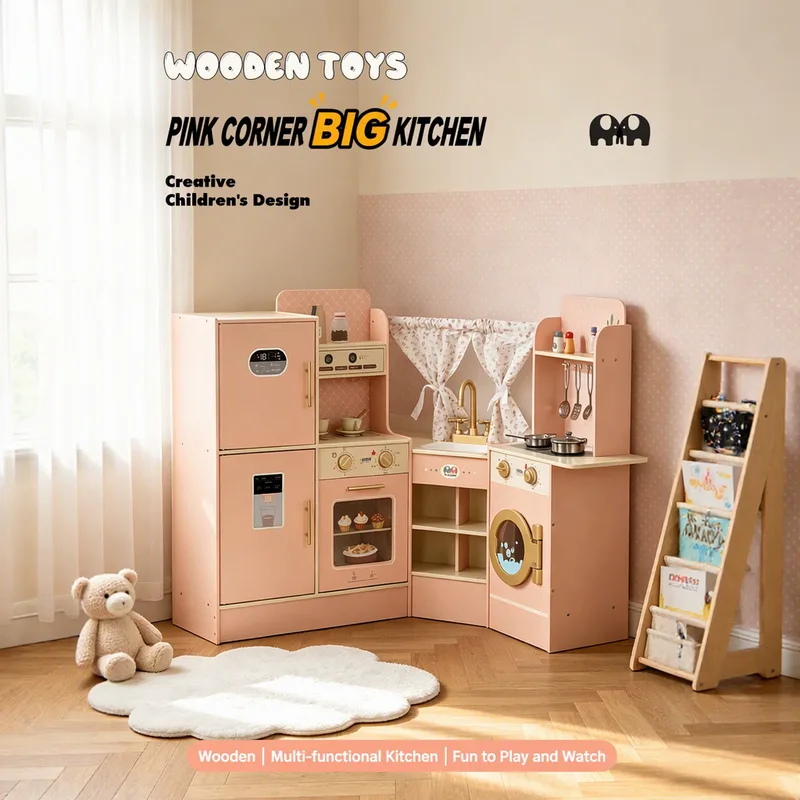
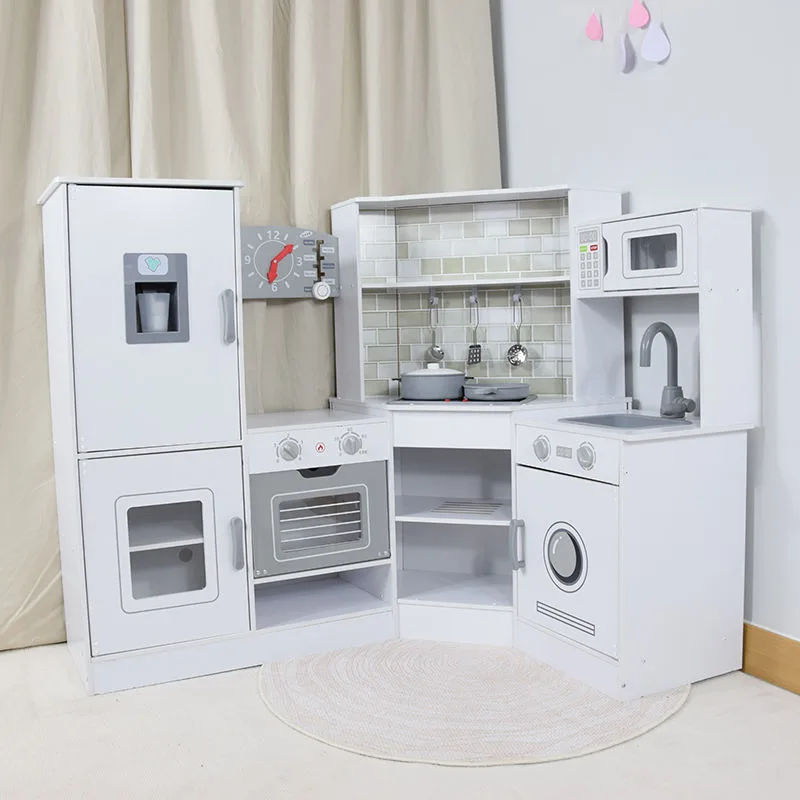
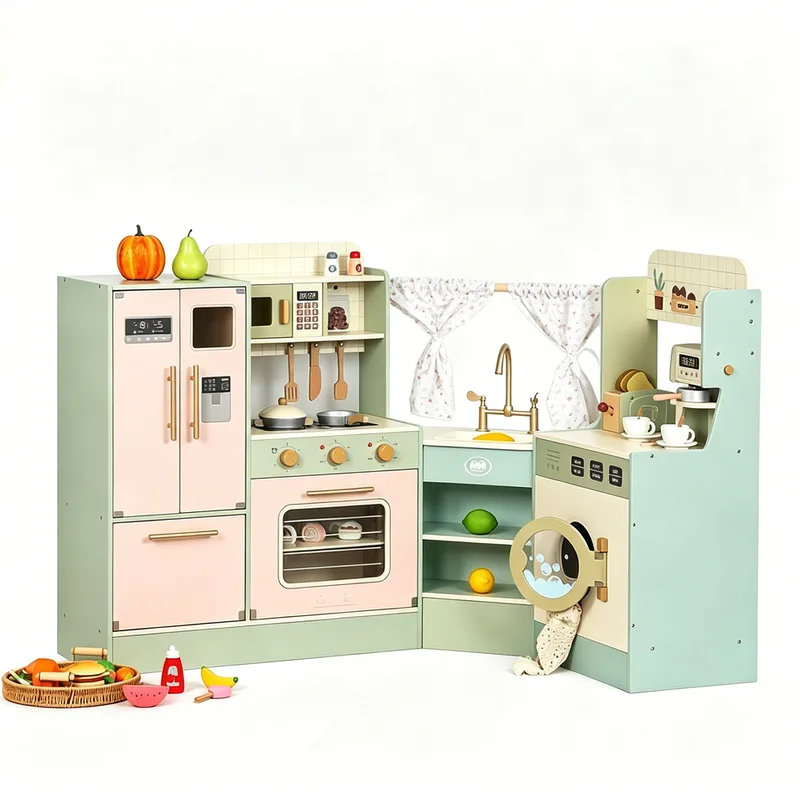
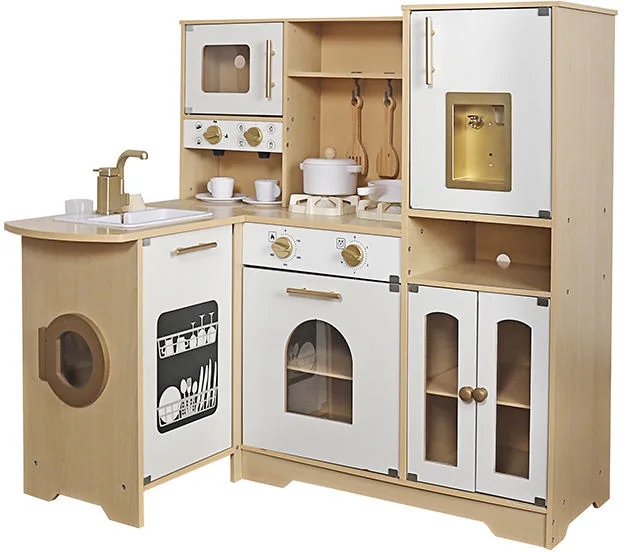
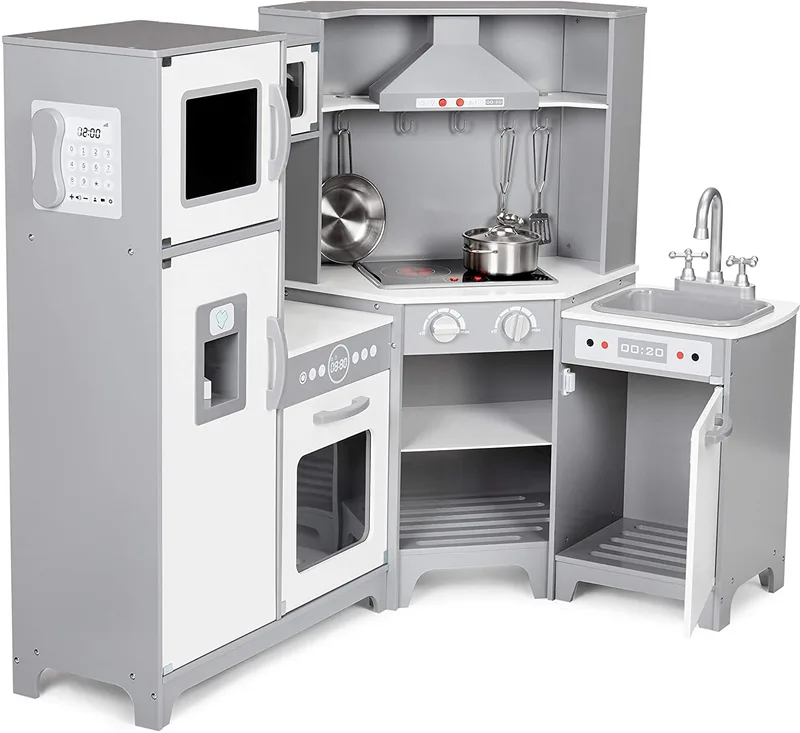
A corner wooden play kitchen solves a layout problem rather than a product problem. The L-shaped body runs along two walls, so the hob and sink can sit on different legs and the child stands inside the angle. For a playroom or a store display that already has a dead corner, that is a good trade; for an open room it usually is not, because the format wastes one leg against a wall the child cannot reach. The decisions that matter are leg length, corner clearance, and how the L is packed.
What the corner format actually is
The body is a straight run with a return: two carcasses joined at 90°, or one carcass shaped around the corner, with the worktop following the angle. Hob and sink usually split across the legs; storage sits under the corner. Some models add a shelf or a small bench on the return, which is what makes the format feel like a real kitchen corner rather than two boxes pushed together.
Two construction approaches exist. A one-piece L arrives in a single wide carton and is awkward on parcel networks; a split L arrives as a main unit plus a return or bridge carton, which is easier to ship but needs two part numbers on the order and two carton labels on the pallet. Ask which one a model uses before you quote a container plan, because a two-carton SKU changes both CBM and picking.
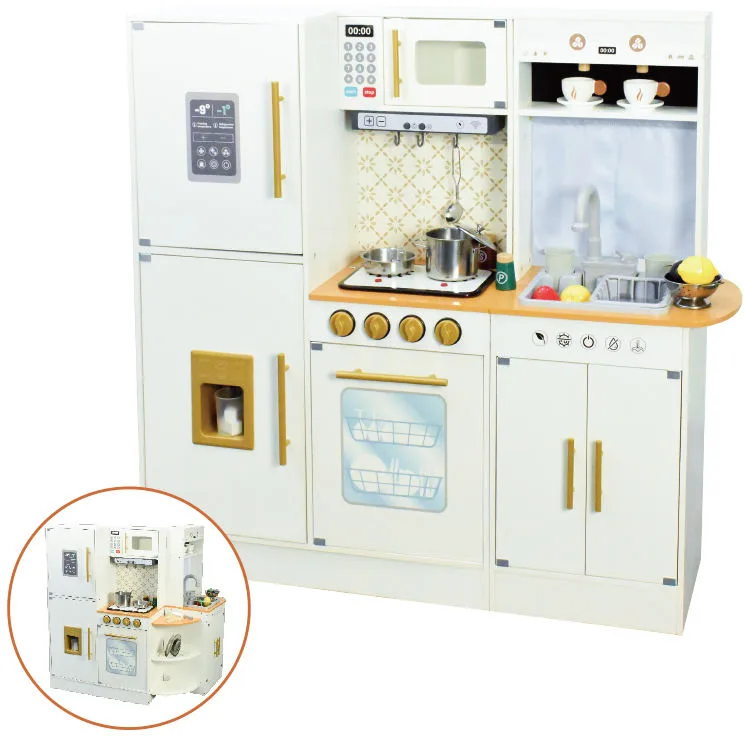
The format is usually the smallest line in a catalogue for a reason: fewer rooms can take it than can take a straight run. If the room has one usable wall rather than a real corner, a complete play kitchen is the safer anchor and the corner vs straight comparison gives the decision test.
How to choose a corner model
Measure the corner before the model. You need the clear wall length on each leg, the height of any skirting board, and the position of radiators, sockets, or a window reveal. A leg that fits the wall but not the skirting ends up standing 2 cm (0.8 in) off the wall with a visible gap.
Choose the leg split by who plays. Preschool rooms usually want a short leg for the sink and a longer leg for the hob plus storage, so two children can stand without colliding. Home channels more often want a compact L that fits a bedroom corner, where both legs are short and the corner itself carries the oven. Height follows the same rule as straight kitchens — 50–55 cm (19.7–21.7 in) worktop for three- and four-year-olds, up to 60 cm (23.6 in) for six-year-olds — and the 60 cm vs 80 cm page explains why that single number changes so much.
Ask about the back panel too. A corner unit is seen from two walls, so one exposed side is normal, but a model with a finished back on both legs can be turned round and used against a half-wall, which widens the rooms it fits.
Dimensions and footprint
Corner models are quoted as leg A × leg B, not width × depth. The corner footprint — the square at the angle that the two legs occupy — is the number to put against a floor plan. Leg lengths in the category typically run 90–140 cm (35.4–55.1 in), with the shorter leg the more common compromise for home channels.
| Specification | Typical range (cm) | Typical range (in) | Confirm with the supplier |
|---|---|---|---|
| Leg A (long run) | 90–140 | 35.4–55.1 | Along the wall, outer carcass |
| Leg B (return) | 70–120 | 27.6–47.2 | Along the return wall |
| Body depth | 30–40 | 11.8–15.7 | Both legs, tap excluded |
| Corner footprint | 80 × 80 to 140 × 140 | 31.5 × 31.5 to 55.1 × 55.1 | Square at the angle |
| Worktop height | 50–60 | 19.7–23.6 | Front edge of each leg |
| Clear floor with doors open | 90–120 | 35.4–47.2 | Worst door of either leg |
Every figure is typical for the category and confirmed per model. The dimensions data page carries the measured baseline used here, and the dimensions guide shows the conversion arithmetic for comparing an L against a straight run.
Packing, CBM, and MOQ
A split L typically ships as two cartons: a main carcass carton and a return or bridge carton, often boxed together in one outer if the channel wants a single barcode. A single-carton one-piece L can reach 0.35 CBM on its own because one dimension has to exceed the longest leg.
Work the numbers before committing to a container mix. A main carton of 105 × 45 × 20 cm (41.3 × 17.7 × 7.9 in) is 0.09 CBM and a return carton of 85 × 40 × 15 cm (33.5 × 15.7 × 5.9 in) is 0.05 CBM, so the pair is about 0.14 CBM, typical. On a 20GP planning figure of roughly 28 CBM that is around 200 sets, subject to gross weight and pallet height. The CBM and container loading guide covers pallet patterns in more detail.
MOQ follows the format rather than the finish: corner models are lower-volume lines, so typical bands start around 100 sets per colour and can rise if the return is made in a separate colourway. Lead time is typically 35–55 days from sample confirmation. Because the shelf is short, most buyers take corner models as a mixed-container line rather than a standalone order.
Common misjudgments
- Using wall length as leg length. Usable leg length is the wall minus skirting, reveal, and any radiator.
- Planning the L into a corner where the child approaches only one leg, turning the return into dead storage.
- Ignoring which door is the "worst" one and under-budgeting clear floor in front of the angle.
- Assuming a one-piece L and a split L take the same freight. The single wide carton is often the less efficient of the two.
- Quoting a corner model against a straight model's MOQ; the bands differ.
- Forgetting that a two-carton SKU needs two labels, two barcodes on the outer, and a picking rule.
A corner wooden play kitchen rewards buyers who measure first. Confirm leg A and leg B, the corner footprint, the carton split, and the gross weight per carton in writing, then compare the result with a straight run of the same height. Start from the catalogue, check the corner dimensions, and send the room dimensions with the quote request so the reply can answer the fit instead of restating the catalogue.